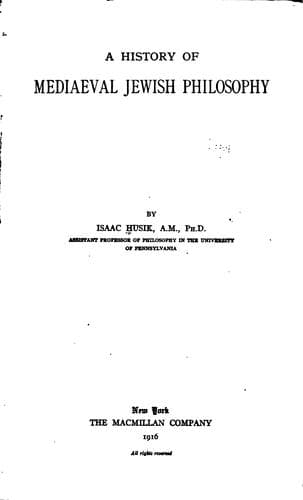
A History of Mediaeval Jewish PhilosophyHusik, Isaac
ReligionJewish
A History of Mediaeval Jewish Philosophy
Husik, Isaac
Philosophy, Jewish; Philosophy, Medieval
If the things of the world are created, someone must have created them.
This is clear. But there may be room for the supposition that this
creative agency is a "_cause_," _i. e._, an impersonal entity, which by
necessity produces other things from itself. Hence we must hasten to say
that this conception of the Creator is impossible because incompatible
with our results so far. A necessarily producing cause cannot be without
creating, hence an eternal cause implies an eternal effect--which
contradicts our idea of a created world proved above. We say, therefore,
that the Creator is not a "cause" but an "agent," _i. e._, one acting
with will and choice.
God is incorporeal because body consists of atoms, and atoms, we have
shown, are created. Besides, if he were corporeal, he could not create
bodies any more than we can. He would furthermore be limited to a
definite place, and the same arguments cited above to prove that atoms
are dependent on a cause would apply to him. Finally we as corporeal
beings cannot exert an influence on objects except by coming in contact
with them. God causes the seed to grow without being in contact with it.
Hence he is not body, and the scriptural passages apparently teaching
the contrary must be explained otherwise.
Jeshua ben Judah likewise agrees with Al-Basir in regarding the nature
of good and evil as absolute, not relative. Like his master he opposes
those who make God's command and prohibition the sole creators of good
and evil respectively, as on the other hand he refuses to agree with the
view that God is bound by necessity to do the good. Our reason
distinguishes between good and evil as our senses between white and
black.
Among other arguments in favor of the absolute character of right and
wrong, which we have already found in Al-Basir, appears the following.
If good and evil mean simply that which God commands and prohibits
respectively, and the distinction holds only for us but not for God, it
follows that God may do what we think is evil. If this be so, we have no
ground for believing in the good faith of the prophet--God might have
sent him to deceive us--and the alleged basis of right and wrong is
removed.
We conclude therefore that good and evil are absolute and are binding
upon God as well. God can do evil as well as good, but being omnipotent
he can accomplish his purpose just as easily by doing good as by doing
evil, and hence surely prefers to do good. Besides, all evil doing is
the result of some need, but God has no needs, being self-sufficient,
hence he does not do evil.
It follows from the above that God had a purpose in creating the world.
For an act without a purpose is vain and hence bad. This purpose cannot
have been egoistic, since God is without need, being above pleasure and
pain. The purpose must therefore have been the well-being of his
creatures.
CHAPTER V
SOLOMON IBN GABIROL
Public-domain text, read in full here on John Shaqi.
Reviews
Reviews
No reviews yet
Be the first to share your thoughts on this work.
Elsewhere in the archive
Join the Discussion
Join the discussion
Sign in to leave a comment or review.
Sign InorCreate an account