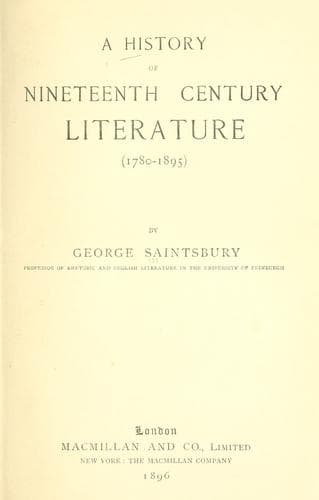
A History of Nineteenth Century Literature (1780-1895)Saintsbury, George
History
A History of Nineteenth Century Literature (1780-1895)
Saintsbury, George
English literature -- 19th century -- History and criticism
Between the death of Byron and the distinct appearance of Tennyson and
the Brownings there was a kind of interregnum or twilight of poetry, of
which one of its strangest if not least illuminative stars or meteors,
Beddoes, has given a graphic but uncomplimentary picture in a letter:
"owls' light" he calls it, with adjuncts. Wordsworth, Coleridge, and
Southey; Scott, Campbell, and Moore, were all living, but the poetic
production of all had on the whole ceased. Shelley and Keats would have
been in time the natural, and in genius the more than sufficient sun
and moon of the time; but they had died before Byron. So the firmament
was occupied by rather wandering stars: some of them elders already
noticed, others born in the ten or twelve years between Keats (1795) and
the eldest of the Tennysons (1807). The chief of these were the pair of
half-serious, half-humorous singers, Hood and Praed. Next in public
estimation come Talfourd, Hartley Coleridge, Macaulay, Sir Henry Taylor,
the Irish poet Mangan, R. H. Horne, and the first Lord Lytton; while a
third class--of critics' rather than readers' favourites--varying in
merit, but, at the best of the best of them, ranking higher than any of
the above, may be made up of George Darley, C. J. Wells, the Dorsetshire
poet Barnes, Beddoes, Charles Whitehead, R. S. Hawker, and Thomas Wade.
To the second class must be added "L. E. L.," the poetess who filled the
interval between Mrs. Hemans and Mrs. Browning.
Wells, Whitehead, and Wade may be dismissed without disrespect as, if
not critical mares'-nests, at any rate critical hobbies. Persons of more
or less distinction (and of less or more crotchet) have at different
times paid very high compliments to the _Joseph and his Brethren_ (1823,
revised later) of Charles Jeremiah Wells (1800-1879), a friend of Keats,
and a person who seems to have lived much as he pleased; to the
_Solitary_ of Charles Whitehead (1804-1862), a Bohemian ne'er-do-weel,
who also showed talent as a novelist and miscellanist; and to the _Mundi
et Cordis Carmina_ (1835) of Thomas Wade (1805-1875), a playwright and
journalist. Of the three, Wade appears to me to have had the greatest
poetical talent. But I do not think that any one who on the one hand
uses epithets in poetical criticism with caution, and on the other has
read a great deal of minor poetry as it appears, could put any one of
them very high. All were born late enough to breathe the atmosphere of
the new poetry young; all had poetical velleities, and a certain amount,
if not of originality, of capacity to write poetry. But they were not
poets; they were only poetical curiosities.
Public-domain text, read in full here on John Shaqi.
Reviews
Reviews
No reviews yet
Be the first to share your thoughts on this work.
Elsewhere in the archive
Join the Discussion
Join the discussion
Sign in to leave a comment or review.
Sign InorCreate an account