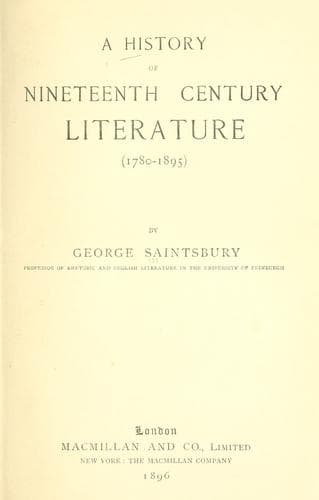
A History of Nineteenth Century Literature (1780-1895)Saintsbury, George
History
A History of Nineteenth Century Literature (1780-1895)
Saintsbury, George
English literature -- 19th century -- History and criticism
Sir Henry Taylor's poetical repute illustrates the converse of the
proposition which is illustrated by that of Horne. It is probable that,
if each is measured by his best things, _Orion_ and _Philip Van
Artevelde_, Horne must be allowed to be a good deal the better poet. But
a placid official life enabled Taylor both to gain powerful friends and
to devote himself to literature merely when and how he pleased. And so
he has burdened his baggage with no mere hack-work. He was indeed a
singularly lucky person. The son of a man of fair family but reduced
fortune who had taken to farming, Henry Taylor began in the navy. But he
disliked the service very much, and either obtained or received his
discharge after only nine months' sea life as a mid-shipman during the
year 1814. Then he entered the public store-keeper's department, but was
ousted by rearrangements after four years' service. These beginnings
were not very promising; but his father allowed him to stay quietly at
home till by pure luck he obtained a third post under Government in the
Colonial Office. This he held for nearly fifty years, during which it
gave him affluence and by degrees a very high position, and left him
abundance of time for society and letters. He resigned it in 1872, and
died on 27th March 1886. He wrote some prose of various kinds, and just
before his death published a pleasant autobiography. But his literary
fame rests on a handful of plays and poems, all of them, except _St.
Clement's Eve_, which did not appear till 1862, produced at leisurely
intervals between 1827 (_Isaac Comnenus_) and 1847 (_The Eve of the
Conquest_ and other poems). The intervening works were _Philip Van
Artevelde_ (his masterpiece, 1834), _Edwin the Fair_ (1842), some minor
poems, and the romantic comedy of _A Sicilian Summer_ (first called _The
Virgin Widow_), which was published with _St. Clement's Eve_. He had
(as, it may be noted curiously, had so many of the men of the transition
decade in which he was born) a singular though scanty vein of original
lyric snatch, the best example of which is perhaps the song "Quoth
tongue of neither maid nor wife" in _Van Artevelde_; but his chief
appeal lay in a very careful study of character and the presentation of
it in verse less icy than Talfourd's and less rhetorical than Milman's.
Yet he had, unlike either of these, very little direct eye to the stage,
and therefore is classed here as a poet rather than as a dramatist.
There is always a public for what is called "thoughtful" poetry, and
Taylor's is more than merely thoughtful. But it may be suspected by
observers that when Robert Browning came into fashion Henry Taylor went
out. Citations of _Van Artevelde_, if not of the other pieces (none of
which are contemptible, while the two last, inferior in weight to their
predecessors, show advance in ease and grace), are very frequent between
1835 and 1865: rare I think between 1865 and 1895.
Public-domain text, read in full here on John Shaqi.
Reviews
Reviews
No reviews yet
Be the first to share your thoughts on this work.
Elsewhere in the archive
Join the Discussion
Join the discussion
Sign in to leave a comment or review.
Sign InorCreate an account