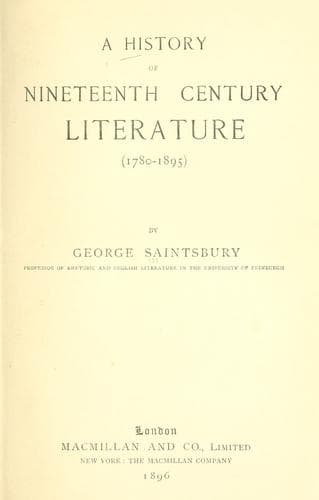
A History of Nineteenth Century Literature (1780-1895)Saintsbury, George
History
A History of Nineteenth Century Literature (1780-1895)
Saintsbury, George
English literature -- 19th century -- History and criticism
The still shorter life of Winthrop Mackworth Praed, on the other hand,
was passed under sufficiently favourable stars. He was born in 1802, and
his father, Serjeant Praed, possessed property, practice at the bar, and
official position. Praed was sent to Eton, where he became a pillar of
the famous school magazine _The Etonian_, and thence to Trinity College,
Cambridge, where he did extremely well, made the acquaintance of
Macaulay, and wrote in _Knight's Quarterly_. After a short interval of
tutoring and reading for the bar he entered Parliament in 1830, and
remained in it for the rest of his life, which closed on 15th July 1839.
He had latterly been secretary to the Board of Control, and it was
thought that, had he lived, he might have made a considerable political
reputation both as speaker and administrator.
The almost unchequered sunshine of one of these careers and the little
sun and much shadow of the other have left traces--natural though less
than might be supposed--of difference between the produce of the two
men; but perhaps the difference is less striking than the resemblance.
That Hood--obliged to write for bread, and outliving Praed by something
like a decade at the two ends--wrote a great deal more than Praed did is
of little consequence, for the more leisurely writer is as unequal as
the duty labourer. Hood had the deeper and stronger genius: of this
there is no doubt, and the advantage more than made up for Praed's
advantages in scholarship and in social standing and accomplishment. In
this serious work of Hood's--_Lycus the Centaur_, _The Plea of the
Midsummer Fairies_, _The Elm Tree_, _The Haunted House_--there is
observable--to a degree never surpassed by any of the poets of this
group except Beddoes, and more sustained and human, though less weird
and sweet, than his--a strain of the true, the real, the ineffable tone
of poetry proper. At this Praed never arrives: there are at most in him
touches which may seem to a very charitable judgment to show that in
other circumstances sorrow, passion, or the like might have roused him
to display the hidden fire. On the other hand, neither Hood's breeding,
nor, I think, his nature, allowed him to display the exquisite airiness,
the delicate artificial bloom and perfection, of Praed's best _vers de
societe_--the _Season_, the _Letter of Advice_, and the rest. This last
bloom has never been quite equalled--even Prior's touch is coarse to it,
even that of the late Mr. Locker is laboured and deliberate. So too as
there is nothing in Praed of the popular indignation--generous and fine
but a little theatrical--which endears Hood to the general in _The
Bridge of Sighs_ and _The Song of the Shirt_, so there is nothing in
Hood of the sound political sense, underlying apparent banter, of
Praed's _Speaker Asleep_ and other things.
Public-domain text, read in full here on John Shaqi.
Reviews
Reviews
No reviews yet
Be the first to share your thoughts on this work.
Elsewhere in the archive
Join the Discussion
Join the discussion
Sign in to leave a comment or review.
Sign InorCreate an account