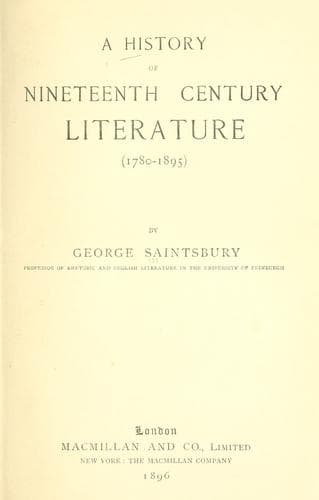
A History of Nineteenth Century Literature (1780-1895)Saintsbury, George
History
A History of Nineteenth Century Literature (1780-1895)
Saintsbury, George
English literature -- 19th century -- History and criticism
Although, as was shown in the first chapter, the amount of novel writing
in the last decades of the eighteenth century was very considerable, and
the talent displayed by at least some of the practitioners of the form
distinctly great, it can hardly have been possible for any careful
observer of it, either during the last ten years of the old age or the
first fifteen of the new, to be satisfied with it on the whole, or to
think that it had reached a settled or even a promising condition. Miss
Burney (now Madame d'Arblay), whose brilliant debut with _Evelina_ was
made just before the date at which this book begins, had just after that
date produced _Cecilia_, in which partial and contemporary judges
professed to see no falling off. But though she was still living and
writing,--though she lived and wrote till the present century was nearly
half over,--_Camilla_ (1796) was acknowledged as a doubtful success, and
_The Wanderer_ (1814) as a disastrous failure; nor after this did she
attempt the style again.
The unpopularity of Jacobinism and the growing distaste for the
philosophy of the eighteenth century prevented much attempt being made
to follow up the half political, half philosophical novel of Godwin,
Holcroft, and Bage. No such causes, however, were in operation as
concerning the "Tale of Terror," the second founder of which, Monk
Lewis, was indeed no inconsiderable figure during the earlier part of
the great age of 1810-30, while Charles Robert Maturin improved
considerably upon Lewis himself. Maturin was born in Ireland (where he
principally lived) in 1782, and died there in 1824. He took orders, but
was too eccentric for success in his profession, and his whole heart was
set on literature and the drama. Befriended by Scott and Byron, though
very severely criticised by Coleridge, he succeeded in getting his
tragedy of _Bertram_ acted at Drury Lane with success; but his later
theatrical ventures (_Manuel_, _Fredolpho_) were less fortunate. He also
published sermons; but he lives in literature only by his novels, and
not very securely by these. He produced three of them--_The Fatal
Vengeance: or, The Family of Montorio_, _The Wild Irish Boy_, and the
_Milesian Chief_--under a pseudonym before he was thirty; while after
the success of _Bertram_ he avowed _Women_ (1818), _Melmoth the
Wanderer_ (1820), and _The Albigenses_ (1824), the last in a sort of
cross style between his earlier patterns and Scott. But his fame had
best be allowed to rest wholly on _Melmoth_, a remarkable book dealing
with the supposed selling of a soul to the devil in return for prolonged
life; the bargain, however, being terminable if the seller can induce
some one else to take it off his hands. Although far too long,
marvellously involved with tales within tales, and disfigured in parts
by the rant and the gush of its class, _Melmoth_ is really a powerful
book, which gave something more than a passing shudder to its own
Public-domain text, read in full here on John Shaqi.
Reviews
Reviews
No reviews yet
Be the first to share your thoughts on this work.
Elsewhere in the archive
Join the Discussion
Join the discussion
Sign in to leave a comment or review.
Sign InorCreate an account