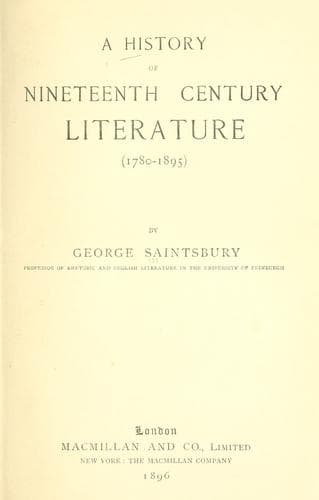
A History of Nineteenth Century Literature (1780-1895)Saintsbury, George
History
A History of Nineteenth Century Literature (1780-1895)
Saintsbury, George
English literature -- 19th century -- History and criticism
been one of the most popular of all abroad, and not the least so at
home; and there are critics who rank _Anne of Geierstein_, in 1829, very
high indeed. Few defenders are found for _Count Robert of Paris_, which
was in fact written in the valley of the shadow; and it may be admitted
that in his earlier days Scott would certainly have been able to give it
a fuller development and a livelier turn. Yet the opening scene, though
a little too long, the escape from the vaults of the Blachernal, and not
a few other things, would be recognised as marvellous if they could be
put before a competent but unbiassed taste, which knew nothing of Sir
Walter's other work, but was able to compare it not merely with the work
of his predecessors but with that of his imitators, numerous and
enterprising as they were, at the time that _Count Robert_ appeared.
In such a comparison Scott at his worst excels all others at their best.
It is not merely that in this detail and in that he has the mastery, but
that he has succeeded in making novel writing in general turn over a
completely new leaf, enter upon a distinctly different competition.
With the masterpieces of the eighteenth century novel he does not enter
into comparison at all: he is working on a different scene, addressing a
different audience, using different tools, colours, methods. Every
successful novelist up to his time had, whatever his ostensible "_temp._
of tale," quietly assumed the thoughts, the speech, the manners, even to
a great extent the dress and details of his own day. And in this
assumption all but the greatest had inevitably estranged from them the
ears and eyes of days that were not their own, which days, no doubt,
were in turn themselves rapidly hastening to change, but never to revert
to the original surroundings. Scott had done in prose fiction what the
poets and the dramatists had sometimes done, what very rare philosophers
had sometimes done likewise. Ostensibly going to the past, and to some
extent really borrowing its circumstances, he had in reality gone
straight to man as man; he had varied the particular trapping only to
exhibit the universal substance. The Baron of Bradwardine, Dandie
Dinmont, Edie Ochiltree, Mause Headrigg, Bailie Jarvie, and the long
list of originals down to Oliver Proudfute and even later, their less
eccentric companions from Fergus MacIvor to Queen Margaret, may derive
part of their appeal from dialect and colouring, from picturesque
"business" and properties. But the chief of that appeal lies in the fact
that they are all men and women of the world, of life, of time in
general; that even when their garments, even when their words are a
little out of fashion, there is real flesh and blood beneath the
garments, real thought and feeling behind the words. It may be urged by
the Devil's Advocate, and is not wholly susceptible of denial by his
opponent, that, after the first four or five books, the enormous gains
Public-domain text, read in full here on John Shaqi.
Reviews
Reviews
No reviews yet
Be the first to share your thoughts on this work.
Elsewhere in the archive
Join the Discussion
Join the discussion
Sign in to leave a comment or review.
Sign InorCreate an account