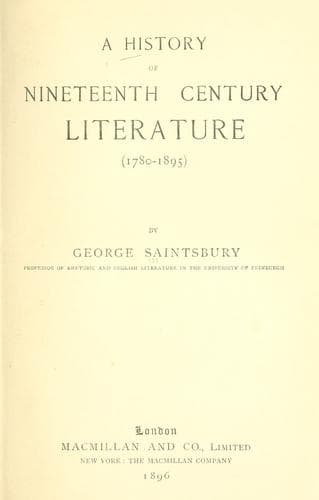
A History of Nineteenth Century Literature (1780-1895)Saintsbury, George
History
A History of Nineteenth Century Literature (1780-1895)
Saintsbury, George
English literature -- 19th century -- History and criticism
the general public; and they kept it much longer (if indeed they have
yet lost it) with schoolboys. But while the attempt of both to imitate
Scott was palpable always, the success of neither could be ranked very
high by severe criticism. James wrote better than Ainsworth: his
historical knowledge was of a much wider and more accurate kind, and he
was not unimbued with the spirit of romance. But the sameness of his
situations (it became a stock joke to speak of the "two horsemen" who so
often appeared in his opening scenes), the exceedingly conventional
character of his handling, and the theatrical feebleness of his
dialogue, were always reprehended and open to reprehension. Harrison
Ainsworth, on the other hand, had a real knack of arresting and keeping
the interest of those readers who read for mere excitement: he was
decidedly skilful at gleaning from memoirs and other documents scraps of
decoration suitable for his purpose, he could in his better days string
incidents together with a very decided knack, and, till latterly, his
books rarely languished. But his writing was very poor in strictly
literary merit, his style was at best bustling prose melodrama, and his
characters were scarcely ever alive.
The chief follower of Sir Walter Scott in "Scotch" novels--for Miss
Ferrier, the Scottish counterpart of Miss Edgeworth and Miss Austen,
was, though his friend, hardly his follower, and _Marriage_ was mainly
written before _Waverley_--was John Galt, who also has some claim to
priority. He was born (2nd May 1779) at Irvine in Ayrshire, the scene of
his best work, but passed most of his youth at Greenock. His father was
a retired West India captain; and Galt's biographers do not make it very
clear whence he obtained the capital for the various travels and
enterprises which occupied his not exactly eventful, but busy and
varied life. He had entered the Custom-house; but went to London in
1804, and tried literature in many forms, and for the most part with
very little success. While travelling in the Levant he met Byron, of
whom long afterwards he published a rather absurd life; and after his
return home his _Ayrshire Legatees_ found welcome and popularity in
_Blackwood_. This was in 1821, and after five years' busy writing Galt
went to Canada in charge of a great scheme of colonisation and commerce
called the Canada Company. This, after fair prospects, broke down
completely. He came back again, wrote hard, and schemed incessantly. But
fortune was not kind to him; and he died, in a way a broken man, at
Greenock on 11th April 1839.
Public-domain text, read in full here on John Shaqi.
Reviews
Reviews
No reviews yet
Be the first to share your thoughts on this work.
Elsewhere in the archive
Join the Discussion
Join the discussion
Sign in to leave a comment or review.
Sign InorCreate an account