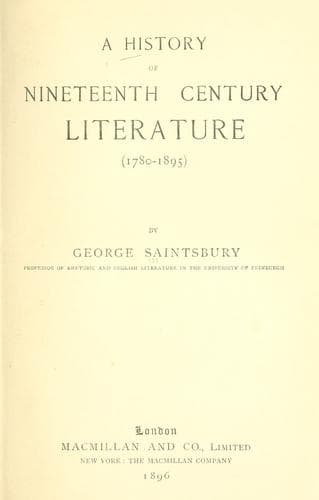
A History of Nineteenth Century Literature (1780-1895)Saintsbury, George
History
A History of Nineteenth Century Literature (1780-1895)
Saintsbury, George
English literature -- 19th century -- History and criticism
The first series of Hook's _Sayings and Doings_ appeared in 1824, the
year before that of the novels of James and Ainsworth above noticed.
Three years later, and five before Scott's death, appeared _Falkland_,
the first (anonymous) novel of a writer far surpassing any of the hour
in talent, and credited by some with positive genius. Edward George
Earle Lytton Bulwer, afterwards Sir Edward Lytton-Bulwer, and later
still Lord Lytton (born in 1800), was the youngest son of General Bulwer
of Wood Dalling and Haydon in Norfolk, while he on his mother's side
represented an ancient Hertfordshire family seated at Knebworth. He was
a Cambridge man: he obtained the Chancellor's prize for English verse in
1825, and his first books were in poetical form. He became a Member of
Parliament, being returned in the Whig interest for St. Ives before the
Reform Bill passed, and in the first Reform Parliament for Lincoln, and
he held this seat for a decade, receiving his baronetcy in 1835. For
another decade he was out of the House of Commons, though he succeeded
to the Knebworth estate in 1844. He was returned for Hertfordshire in
1852, and, joining Lord Derby's reconstituted party, ranked for the rest
of his life as a Conservative of a somewhat Liberal kind. In the second
Derby administration he was Colonial Secretary, but took no part in that
of 1867, and died just before the return of the Tories to power in 1873.
This sufficiently brilliant political career was complicated by literary
production and success in a manner not equalled by any Englishman of his
time, and only approached by Macaulay and by Mr. Disraeli. _Falkland_
was succeeded by _Pelham_, which was published with his name, and which
was the first, perhaps the most successful, and by far the most
brilliant, of the novels in which authors have endeavoured to secure
the rank of man of the world even more than that of man of letters,
taking the method chiefly of fashionable, and therefore somewhat
ephemeral, epigram. Nor did Bulwer (as he was known in the heyday of his
popularity) ever cease novel writing for the forty-five years which were
left to him, while the styles of his production varied with fashion in a
manner impossible to a man of less consummate versatility and talent,
though perhaps equally impossible to one of a very decided turn of
genius. The fashionable novel, the crime novel, the romance of mystery,
the romance of classical times, the historical novel, by turns occupied
him; and it is more easy to discover faults in _Paul Clifford_, _Eugene
Aram_, _The Pilgrims of the Rhine_, _The Last Days of Pompeii_, _Ernest
Maltravers_, _Zanoni_, _Rienzi_, _The Last of the Barons_, and _Harold_,
than to refuse admiration to their extraordinary qualities. Then their
author, recognising the public taste, as he always did, or perhaps
exemplifying it with an almost unexampled quickness, turned to the
domestic kind, which was at last, more than thirty years after Miss
Public-domain text, read in full here on John Shaqi.
Reviews
Reviews
No reviews yet
Be the first to share your thoughts on this work.
Elsewhere in the archive
Join the Discussion
Join the discussion
Sign in to leave a comment or review.
Sign InorCreate an account