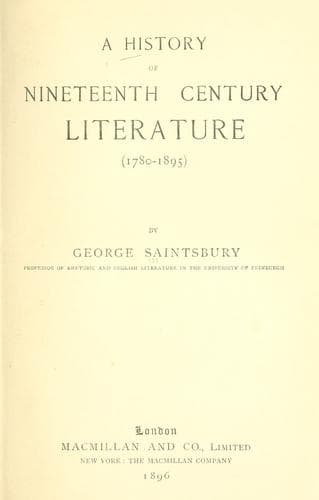
A History of Nineteenth Century Literature (1780-1895)Saintsbury, George
History
A History of Nineteenth Century Literature (1780-1895)
Saintsbury, George
English literature -- 19th century -- History and criticism
Yet it has been sometimes complained, sometimes boasted, that "with the
critics Bulwer is dead"; and it is not very certain that with the
faithful herd of uncritical readers the first Lord Lytton keeps any
great place. Even many years ago he had ceased to be, if he ever was, a
general favourite with those who specially loved literature; and it is
rather doubtful whether he will ever regain even a considerable vogue of
esteem. Perhaps this may be unjust, for he certainly possessed ability
in bulk, and perhaps here and there in detail, far surpassing that of
all but the very greatest of his contemporaries. Even the things which
were most urged against him by contemporary satirists, and which it is
to be feared are remembered at second-hand when the first-hand knowledge
of his work has declined, need not be fatal. A man may write such things
as "There is an eloquence in Memory because it is the nurse of Hope"
without its being necessary to cast up his capital letters against him
in perpetuity, or to inquire without ceasing whether eloquence is an
inseparable property of nurses. But he had two great faults--want of
concentration and want of reality; and the very keenness, the very
delicacy of his appreciation of the shiftings of popular taste may seem
without unfairness to argue a certain shallowness of individual soil, a
literary compost wherein things spring up rapidly because they have no
depth of earth, but also because they have no depth of earth, rapidly
vanish and wither away. The novel and the magazine have beyond all doubt
given us much admirable work which without them we should not have had;
they have almost as certainly, and in no case much more certainly than
in Bulwer's, over-forced and over-coaxed into hasty and ephemeral
production talents which, with a little more hardening and under less
exacting circumstances, might have become undoubted genius. Sentimental
grandiloquence is not by itself fatal: the fashion which tempts to it,
which turns on it, may return to it again; and it is never impossible to
make allowance for its excesses, especially when, as in the case under
discussion, it is accompanied by a rare and true satiric grasp of life.
In these early externals of his, Bulwer was only the most illustrious of
the innumerable victims of Byron. But his failure to make his figures
thoroughly alive is more serious; and this must be put down partly to
incapacity to take pains.
Public-domain text, read in full here on John Shaqi.
Reviews
Reviews
No reviews yet
Be the first to share your thoughts on this work.
Elsewhere in the archive
Join the Discussion
Join the discussion
Sign in to leave a comment or review.
Sign InorCreate an account