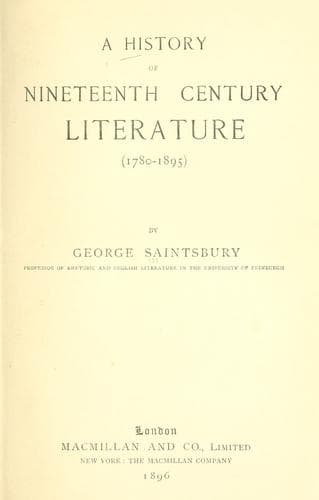
A History of Nineteenth Century Literature (1780-1895)Saintsbury, George
History
A History of Nineteenth Century Literature (1780-1895)
Saintsbury, George
English literature -- 19th century -- History and criticism
The brilliancy and the originality of the product of this can never be
denied. True to his general character of independence, Dickens owes
hardly anything to any predecessor except Smollett, to whom his debts
are rather large, and perhaps to Theodore Hook, to whom, although the
fact has not been generally recognised, they exist. He had had no
regular education, had read as a boy little but the old novelists, and
never became as a man one of either wide learning or much strictly
literary taste. His temperament indeed was of that insubordinate
middle-class variety which rather resents the supremacy of any classics;
and he carried the same feeling into art, into politics, and into the
discussion of the vague problems of social existence which have so much
occupied the last three-quarters of the century. Had this iconoclastic
but ignorant zeal of his (which showed itself in his second novel,
_Nicholas Nickleby_, and was apparent in his last completed one, _Our
Mutual Friend_) been united with less original genius, the result must
have been infinitely tedious, and could not have been in any way
profitable. For Dickens' knowledge, as has been said, was very limited;
his logical faculties were not strong; and while constantly attempting
to satirise the upper classes, he knew extremely little about them, and
has never drawn a single "aristocrat," high government official, or
"big-wig" generally, who presents the remotest resemblance to a living
being. But he knew the lower and lower middle classes of his own day
with wonderful accuracy; he could inform this knowledge of his with that
indefinable comprehension of man as man which has been so often noted;
and over and above this he possessed an imagination, now humorous, now
terrible, now simply grotesque, of a range and volume rarely equalled,
and of a quality which stands entirely by itself, or is approached at a
distance, and with a difference, only by that of his great French
contemporary Balzac. This imagination, essentially plastic, so far
outran the strictly critical knowledge of mankind as mankind just
mentioned that it has invested Dickens' books and characters with a
peculiarity found nowhere else, or only in the instance just excepted.
They are never quite real: we never experience or meet anything or
anybody quite like them in the actual world. And yet in their own world
they hold their position and play their parts quite perfectly and
completely: they obey their own laws, they are consistent with their own
surroundings. Occasionally the work is marred by too many and too
glaring tricks of mannerism: this was especially the case with the
productions of the period between 1855 and 1865. The pathos of Dickens
was always regarded as slightly conventional and unreal by critical
judges. But his humour, though never again attaining the same marvellous
flow of unforced merriment which the _Pickwick Papers_ had shown, was
almost unfailing; and, thanks to the gift of projecting imaginative
Public-domain text, read in full here on John Shaqi.
Reviews
Reviews
No reviews yet
Be the first to share your thoughts on this work.
Elsewhere in the archive
Join the Discussion
Join the discussion
Sign in to leave a comment or review.
Sign InorCreate an account