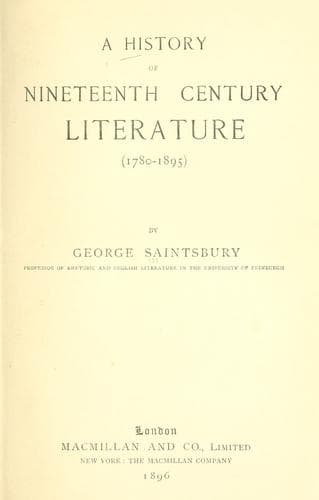
A History of Nineteenth Century Literature (1780-1895)Saintsbury, George
History
A History of Nineteenth Century Literature (1780-1895)
Saintsbury, George
English literature -- 19th century -- History and criticism
But this book, though by no means Dickens' Corunna or even his
Malplaquet, was certainly the climax of his career, and no impartial and
competent critic could ever give him the same praise again. In two long
stories, _Bleak House_ and _Little Dorrit_, and in a shorter one, _Hard
Times_, which appeared between 1852 and 1857, the mania of "purpose" and
the blemish of mechanical mannerism appeared to a far worse degree than
previously, though in the first named at any rate there were numerous
consolations of the old kind. The _Tale of Two Cities_ (1859) has been
more differently judged than any other of his works; some extolling it
as a great romance, if not quite a great historical novel, while others
see in it little more than mixed mannerism and melodrama. Something of
the same difference prevails about _Great Expectations_ (1860-61), the
parties as a rule changing sides, and those who dislike the _Tale of Two
Cities_ rejoicing in _Great Expectations_, Dickens' closest attempt at
real modern life (with a fantastic admixture of course), and in its
heroine, Estella, his almost sole creation of a live girl. _Our Mutual
Friend_ (1864-65), though not a return to the great days, brought these
parties somewhat together again, thanks to the Doll's Dressmaker and
Rogue Riderhood. And then, for it is impossible to found any sound
critical judgment on the fragment of _Edwin Drood_, the building of the
most extraordinary monument of the fantastic in literature ceased
abruptly.
That exactly the same fate befell the great successor, rival, and foil
of Dickens in novel writing during the middle of the century was due to
no metaphysical aid but to the simple and prosaic fact that at the time
publication in parts, independently or in periodicals, was the usual
method. Although the life of William Makepeace Thackeray was as little
eventful as Dickens' own, their origin and circumstances were as
different as their work. Dickens, as has been said, was born in
distinctly the lower section of the middle class, and had, if any
education, a very irregular one. Thackeray, who was born at Calcutta in
1811, belonged to a good family, regularly connected with English public
schools and universities, inherited a small but comfortable fortune, and
was himself educated at the Charterhouse and at Trinity College,
Cambridge, though he took no degree. Unsuccessful as an artist (it is
one of the chief pieces of literary anecdote of our times that he
offered himself fruitlessly to Dickens as an illustrator), and having by
imprudence or accident lost his private means, he began to write,
especially in the then new and audacious _Fraser's Magazine_. For this,
for other periodicals, and for _Punch_ later, he performed a vast amount
of miscellaneous work, part only of which, even with the considerable
addition made some ten years ago, has ever been enshrined in his
collected works. It is all very remarkable, and can easily be seen now
Public-domain text, read in full here on John Shaqi.
Reviews
Reviews
No reviews yet
Be the first to share your thoughts on this work.
Elsewhere in the archive
Join the Discussion
Join the discussion
Sign in to leave a comment or review.
Sign InorCreate an account