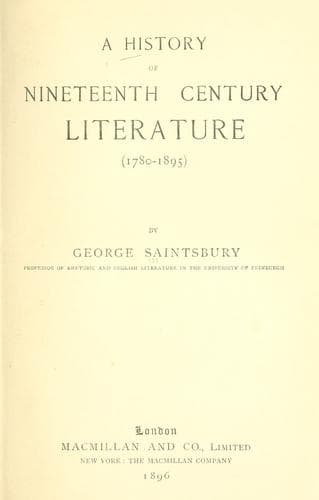
A History of Nineteenth Century Literature (1780-1895)Saintsbury, George
History
A History of Nineteenth Century Literature (1780-1895)
Saintsbury, George
English literature -- 19th century -- History and criticism
The descent, in purely literary merit, from Dickens and Thackeray, and
perhaps from Bulwer, to some of those who must now be mentioned, is
great. Yet the chief naval and the chief military novelist of England
need surely not appear by allowance; and if affection and frequent
reading count for anything, it is not certain that some technically much
greater names might not shine with lesser lustre than those of Marryat
and Lever. Frederick Marryat, the elder of the pair, was born in 1792,
early enough to see a good deal of service in the later years of the
Great War, partly under the brilliant if eccentric leadership of Lord
Cochrane. His promotion was fairly rapid: he became a commander in 1815,
and afterwards distinguished himself as a post captain in the Burmese
War, being made a C.B. in 1825. But the increasing dearth of active
service was not suitable to a character like that of Marryat, who,
moreover, was not likely to be popular with "My Lords"; and his
discovery of a faculty for writing opened up to him, both as novelist
and magazine editor, a very busy and profitable literary career, which
lasted from 1830 to 1848, when he died. Marryat's works, which are very
numerous (the best being perhaps _Peter Simple_, _Mr. Midshipman Easy_,
and _Jacob Faithful_, though there is hardly one that has not special
adherents), resemble Smollett's more than those of any other writer, not
merely in their sea-scenes, but in general scheme and character. Some of
Smollett's faults, too, which are not necessarily connected with the
sea--a certain ferocity, an over-fondness for practical jokes, and the
like--appear in Marryat, who is, moreover, a rather careless and
incorrect writer, and liable to fits both of extravagance and of
dulness. But the spirit and humour of the best of his books throughout,
and the best parts of the others, are unmistakable and unsurpassed. Nor
should it be forgotten that he had a rough but racy gift of verse, the
best, though by no means the only good example of which is the piece
beginning, "The Captain stood on the carronade."
Public-domain text, read in full here on John Shaqi.
Reviews
Reviews
No reviews yet
Be the first to share your thoughts on this work.
Elsewhere in the archive
Join the Discussion
Join the discussion
Sign in to leave a comment or review.
Sign InorCreate an account