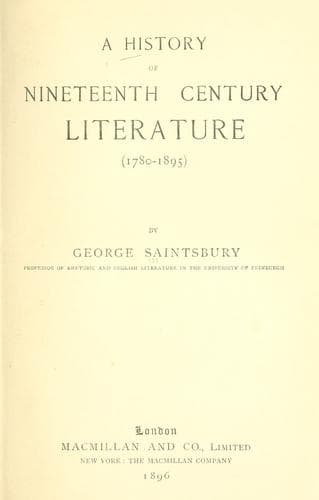
A History of Nineteenth Century Literature (1780-1895)Saintsbury, George
History
A History of Nineteenth Century Literature (1780-1895)
Saintsbury, George
English literature -- 19th century -- History and criticism
George Borrow, who was eighteen years Peacock's junior, and outlived him
by fifteen, was a curious counterpart-analogue to him. Like Peacock, he
was irregularly educated, and yet a wide and deep student; but, unlike
Peacock, he devoted himself not so much to the ancient as to the more
out-of-the-way modern tongues, and became a proficient not merely in
Welsh, the Scandinavian tongues, Russian, Spanish, and other literary
languages, but in Romany or Gipsy, having associated much with the "folk
of Egypt" during his youth. After some very imperfectly known youthful
experiences, which formed at least the basis of his later novels,
_Lavengro_ (1851) and _The Romany Rye_ (1857), he received an
appointment as colporteur to the Bible Society, first in Russia, then in
Spain; and his adventures in the latter country formed the basis of a
study called _The Gipsies of Spain_ (1840), which has much, and a volume
of travel and autobiography, _The Bible in Spain_ (1843), which has
unique interest. Returning home, he married a wife with some money, and
spent the remainder of a long life in his native county of Norfolk,
producing, besides the books just named, _Wild Wales_ (1862), and dying
in 1881. There is, in fact, not very much difference between Borrow's
novels and his travel-books. The former had at least some autobiographic
foundation, and the latter invest actual occurrences with the most
singular flavour of romance. For his mere style Borrow was a little
indebted to Cobbett, though he coloured Cobbett's somewhat drab canvas
with the most brilliant fantastic hues. But his attitude, his main
literary quality, is quite unique. It might be called, without too much
affectation, an adjustment of the picaresque novel to dreamland,
retaining frequent touches of solid and everyday fact. Peacock's style
has found a good many, though no very successful, imitators; Borrow's is
quite inimitable.
Public-domain text, read in full here on John Shaqi.
Reviews
Reviews
No reviews yet
Be the first to share your thoughts on this work.
Elsewhere in the archive
Join the Discussion
Join the discussion
Sign in to leave a comment or review.
Sign InorCreate an account