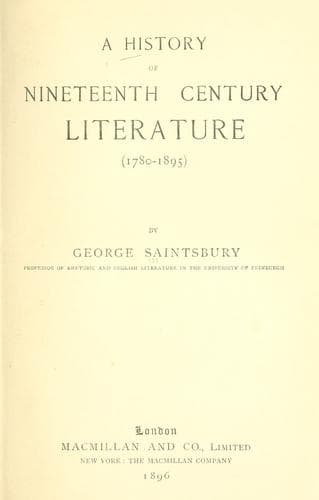
A History of Nineteenth Century Literature (1780-1895)Saintsbury, George
History
A History of Nineteenth Century Literature (1780-1895)
Saintsbury, George
English literature -- 19th century -- History and criticism
of the greatest talent, such as Smollett earlier and Southey just at the
last. But, as a rule, they were in the hands of mere hacks; they paid so
wretchedly that no one, unless forced by want or bitten by an amateurish
desire to see himself in print, would contribute to them; they were by
no means beyond suspicion of political and commercial favouritism; and
their critiques were very commonly either mere summaries or scrappy
"puffs" and "slatings," seldom possessing much grace of style, and
scarcely ever adjusted to any scheme of artistic criticism.
This is a history of literature, not of the newspaper press, and it is
necessary to proceed rather by giving account of the authors who were
introduced to the public by--or who, being otherwise known, availed
themselves of--this new development of periodicals. It may be sufficient
to say here that the landmarks of the period, in point of the birth of
papers, are, besides the two above mentioned, the starting of the
_Quarterly Review_ as a Tory opponent to the more and more Whiggish
_Edinburgh_ in 1809, of the _Examiner_ as a Radical weekly in 1808, of
_Blackwood's Magazine_ as a Tory monthly in 1817, of the _London
Magazine_ about the same time, and of _Fraser_ in 1830.
It was a matter of course that in the direction or on the staff of these
new periodicals some of the veterans of the older system, or of the men
who had at any rate already some experience in journalism, should be
enlisted. Gifford, the first editor of the _Quarterly_, was in all
respects a writer of the old rather than of the new age. Southey had at
one time wholly, and for years partly, supported himself by writing for
periodicals; Coleridge was at different times not merely a contributor
to these, but an actual daily journalist; and so with others. But, as
always happens when a really new development of literature takes place,
new regiments raised themselves to carry out the new tactics, as it
were, spontaneously. Many of the great names and the small mentioned in
the last three chapters--perhaps indeed most of them--took the
periodical shilling at one time or other in their lives. But those whom
I shall now proceed to mention--William Cobbett, Francis Jeffrey, Sydney
Smith, John Wilson, Charles Lamb, Leigh Hunt as a prose writer, William
Hazlitt, Thomas De Quincey, John Gibson Lockhart, and some others--were,
if not exactly journalists (an incorrect, but the only single
designation), at any rate such frequent contributors to periodical
literature of one kind or another that in some cases nothing, in most
comparatively little, would be left of their work if contributions to
newspapers, reviews, and magazines were to be excluded from it.
Public-domain text, read in full here on John Shaqi.
Reviews
Reviews
No reviews yet
Be the first to share your thoughts on this work.
Elsewhere in the archive
Join the Discussion
Join the discussion
Sign in to leave a comment or review.
Sign InorCreate an account