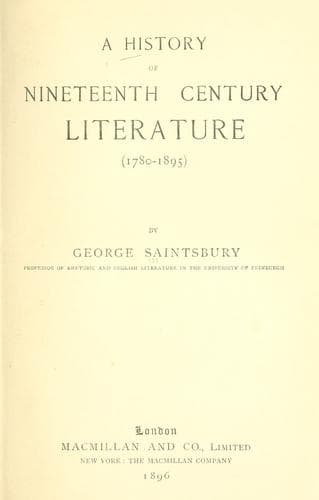
A History of Nineteenth Century Literature (1780-1895)Saintsbury, George
History
A History of Nineteenth Century Literature (1780-1895)
Saintsbury, George
English literature -- 19th century -- History and criticism
Some such details of Cobbett's life are necessary even in the most
confined space, because they are intimately connected with his singular
character and his remarkable works. These latter are enormous in bulk
and of the most widely diversified character. _Peter Porcupine_ fills
twelve not small volumes; the mere selections from the _Register_, which
are all that has been republished of it, six very bulky ones; with a
wilderness of separate works besides--_Rural Rides_, a _History of the
Reformation_, books on husbandry, gardening, and rural economy
generally, some on the currency, an _English Grammar_, and dozens of
others. Of these the _Rural Rides_ is the most interesting in matter and
the most picturesque in style, while it affords a fair panorama of its
author's rugged but wonderfully varied and picturesque mind and
character; the _History of the Reformation_ is the most wrong-headed and
unfair; the currency writings the most singular example of the delusion
that strong prejudices and a good deal of mother-wit will enable a man
to write, without any knowledge, about the most abstruse and complicated
subjects; the agricultural books and the _English Grammar_ the best
instances of genial humours, shrewdness, and (when crotchets do not come
in too much) sound sense. But hardly anything that Cobbett writes is
contemptible in form, however weak he may often be in argument,
knowledge, and taste. He was the last, and he was not far below the
greatest, of the line of vernacular English writers of whom Latimer in
the sixteenth, Bunyan in the seventeenth, and Defoe in the eighteenth,
are the other emerging personalities. To a great extent Cobbett's style
was based on Swift; but the character of his education, which was not in
the very least degree academic, and still more the idiosyncrasy of his
genius, imposed on it almost from the first, but with ever-increasing
clearness, a manner quite different from Swift's, and, though often
imitated since, never reproduced. The "Letter to Jack Harrow," the
"Letter to the People of Botley," the "Letters to Old George Rose," and
that to "Alexander Baring, Loan Monger," to take examples almost at
random from the _Register_, are quite unlike anything before them or
anything after them. The best-known parody of Cobbett, that in _Rejected
Addresses_, gives rather a poor idea of his style; exhibiting no doubt
his intense egotism, his habit of half trivial divagation, and his use
of strong language, but quite failing to give the immense force, the
vivid clearness, and the sterling though not precisely scholarly English
which characterise his good work. The best imitation to be found is in
some of the anonymous pamphlets in which, in his later days, government
writers replied to his powerful and mischievous political diatribes, and
which in some cases, if internal evidence may be trusted, must have been
by no mean hands.
Public-domain text, read in full here on John Shaqi.
Reviews
Reviews
No reviews yet
Be the first to share your thoughts on this work.
Elsewhere in the archive
Join the Discussion
Join the discussion
Sign in to leave a comment or review.
Sign InorCreate an account