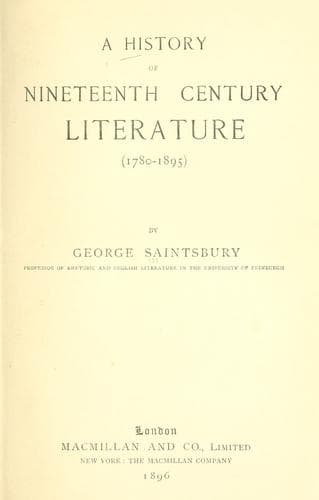
A History of Nineteenth Century Literature (1780-1895)Saintsbury, George
History
A History of Nineteenth Century Literature (1780-1895)
Saintsbury, George
English literature -- 19th century -- History and criticism
Reform Ministry, though they would not give him a bishopric, gave him a
canonry at St. Paul's, and divers legacies and successions made him
relatively a rich man. He died five years before Jeffrey, in February
1845.
Besides the differences of their Scotch and English nationality and
education, the contrast between the two friends and founders of the
"Blue and Yellow" was curiously pervading. Jeffrey, for all his supposed
critical savagery, was a sentimentalist, and had the keenest love of
literature as literature; Sydney cared very little for books as books,
and had not a grain of sentiment in his composition. Jeffrey had little
wit and no humour; Smith abounded in both, and was one of the very
wittiest of Englishmen. Even in his _Review_ articles he constantly
shocked his more solemn and pedagogic editor by the stream of banter
which he poured not merely upon Tories and High Churchmen, but on
Methodists and Non-conformists; his letters are full of the most
untiring and to this day the most sparkling pleasantry; and his two
chief works outside his reviews, the earlier _Peter Plymley's Letters_
and the later _Letters to Archdeacon Singleton_ (written when the
author's early Whiggism had crystallised into something different, and
when he was stoutly resisting the attempts of the reformed government to
meddle with cathedral establishments), rank among the capital light
pamphlets of the world, in company with those of Pascal and Swift and
Courier. The too few remnants of his abundant conversation preserve
faint sparks of the blaze of impromptu fun for which in his day he was
almost more famous than as a writer. Sydney Smith had below the surface
of wit a very solid substratum of good sense and good feeling; but his
literary appeal consisted almost wholly in his shrewd pleasantry,
which, as it has been observed, might with even more appropriateness
than Coleridge said it of Fuller, have been said to be "the stuff and
substance of his intellectual nature." This wit was scarcely ever in
writing--it seems to have been sometimes in conversation--forced or
trivial; it was most ingeniously adjusted to the purpose of the moment,
whether that purpose was a political argument, a light summary of a book
of travels, or a mere gossiping letter to a friend; and it had a quality
of its own which could only be displayed by extensive and elaborate
citation. But if it be possible to put the finger on a single note, it
is one distinguishing Sydney Smith widely from Fuller himself, bringing
him a little nearer to Voltaire, and, save for the want of certain
earnestness, nearer still to Swift--the perfect facility of his jokes,
and the casual, easy man-of-the-worldliness with which he sets them
before the reader and passes on. Amid the vigorous but slightly
ponderous manners of the other early contributors to the _Review_, this
must have been of inestimable value; but it is a higher credit to Sydney
Public-domain text, read in full here on John Shaqi.
Reviews
Reviews
No reviews yet
Be the first to share your thoughts on this work.
Elsewhere in the archive
Join the Discussion
Join the discussion
Sign in to leave a comment or review.
Sign InorCreate an account