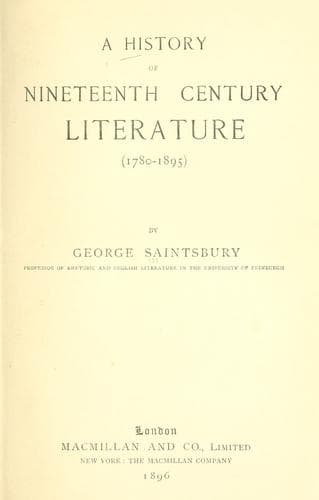
A History of Nineteenth Century Literature (1780-1895)Saintsbury, George
History
A History of Nineteenth Century Literature (1780-1895)
Saintsbury, George
English literature -- 19th century -- History and criticism
Two, however, not of the absolutely first rank, may be mentioned here
more conveniently than anywhere else--Sir John Barrow and Isaac
Disraeli. The former had a rather remarkable career; for he was born, in
1764, quite of the lower rank, and was successively a clerk in a
workshop, a sailor, a teacher of mathematics, and secretary to Macartney
on his famous embassy to China. After following the same patron to South
Africa, Barrow, at the age of forty, became Secretary of the Admiralty,
which post he held with one short break for more than forty years
longer. He was made a baronet in 1835, and died in 1848. Barrow was a
considerable writer on geography and naval history; and one of the
pillars of the _Quarterly_. Isaac Disraeli, son of one Benjamin of that
name and father of another, seems to have been as unlike his famous
offspring as any father could be to any son. Born at Enfield in 1766, he
showed absolutely no taste for business of any kind, and after some
opposition was allowed to cultivate letters. His original work was worth
little; indeed, one of the amiable sayings attributed to his friend
Rogers was that Isaac Disraeli had "only half an intellect." He fell,
however, pretty early (1791) into an odd but pleasant and profitable
course of writing which amused himself during the remainder of a long
life (he died blind in the same year with Barrow), and has amused a vast
number of readers for more than a century. The _Curiosities of
Literature_, the first part of which appeared at the date above
mentioned, to be supplemented by others for more than forty years, were
followed by the _Calamities of Authors_ and the _Quarrels of Authors_
(1812-14), a book on _Charles I._, and the _Amenities of Literature_
(1840). Of these the _Curiosities_ is the type, and it is also the best
of them. Isaac Disraeli was not a good writer; and his original
reflections may sometimes make the reader doubt for a moment whether
Rogers was not more wrong in granting him half an intellect than in
denying him a whole one. But his anecdotage, though, as perhaps such
anecdotage is bound to be, not extremely accurate, is almost
inexhaustibly amusing, and indicates a real love as well as a wide
knowledge of letters.
Public-domain text, read in full here on John Shaqi.
Reviews
Reviews
No reviews yet
Be the first to share your thoughts on this work.
Elsewhere in the archive
Join the Discussion
Join the discussion
Sign in to leave a comment or review.
Sign InorCreate an account