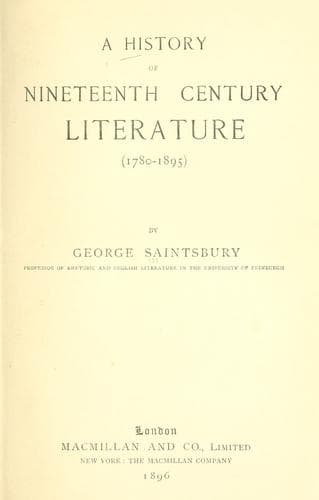
A History of Nineteenth Century Literature (1780-1895)Saintsbury, George
History
A History of Nineteenth Century Literature (1780-1895)
Saintsbury, George
English literature -- 19th century -- History and criticism
It was not, however, till he had well reached middle age that the
establishment of the _London_, the later publishers of which, Taylor and
Hessey, were his friends, gave him that half accidental, and yet it
would seem necessary, opening which has so often made the fame of men of
genius, and which apparently they are by no means often able to make for
themselves. Lamb's poems have occasionally an exquisite pathos and more
frequently a pleasant humour, but they would not by themselves justify a
very high estimate of him; and it is at least possible that, if we had
nothing but the brief critical remarks on the dramatists above noticed,
they would, independently of their extreme brevity, have failed to
obtain for him the just reputation which they now hold, thanks partly to
the fact that we have, as comments on them, the _Essays of Elia_ and the
delightful correspondence. This latter, after being first published soon
after Lamb's death in 1834 (nine years after he had been pensioned off
from the India House), by Mr., afterwards Serjeant and Sir Thomas
Talfourd, has been gradually augmented, till it has at last found an
excellent and probably final editor in Canon Ainger.
It is in these two collections that Lamb presents himself in the
character which alone can confer on any man the first rank in
literature, the character of unicity--of being some one and giving
something which no one before him has given or has been. The _Essays of
Elia_ (a _nom de guerre_ said to have been taken from an Italian comrade
of the writer's elder brother John in the South Sea House, and directed
by Lamb himself to be pronounced "Ell-ia") elude definition not merely
as almost all works of genius do, but by virtue of something essentially
elvish and tricksy in their own nature. It is easy to detect in them--or
rather the things there are so obvious that there is no need of
detection--an extraordinary familiarity with the great "quaint" writers
of the seventeenth century--Burton, Fuller, Browne--which has supplied a
diction of unsurpassed brilliancy and charm; a familiarity with the
eighteenth century essayists which has enabled the writer to construct a
form very different from theirs in appearance but closely connected with
it in reality; an unequalled command over that kind of humour which
unites the most fantastic merriment to the most exquisite pathos; a
perfect humanity; a cast of thought which, though completely conscious
of itself, and not in any grovelling sense humble (Lamb, forgiving and
gentle as he was, could turn sharply even upon Coleridge, even upon
Southey, when he thought liberties had been taken with him), was a
thousand miles removed from arrogance or bumptiousness; an endlessly
various and attractive set of crotchets and whimsies, never divorced
from the power of seeing the ludicrous side of themselves; a fervent
love for literature and a wonderful gift of expounding it; imagination
in a high, and fancy almost in the highest degree.
Public-domain text, read in full here on John Shaqi.
Reviews
Reviews
No reviews yet
Be the first to share your thoughts on this work.
Elsewhere in the archive
Join the Discussion
Join the discussion
Sign in to leave a comment or review.
Sign InorCreate an account