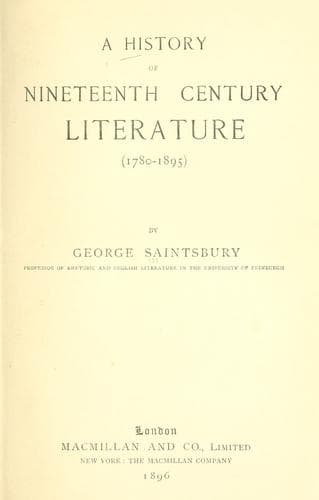
A History of Nineteenth Century Literature (1780-1895)Saintsbury, George
History
A History of Nineteenth Century Literature (1780-1895)
Saintsbury, George
English literature -- 19th century -- History and criticism
frequently and very widely diverge from painting into literary and
miscellaneous matters. The second class contains the miscellaneous
essays proper, and these have by some been put at the head of Hazlitt's
work. But although some of them, indeed, nearly all, display a spirit, a
command of the subject, and a faculty of literary treatment which had
never been given to the same subjects in the same way before, although
such things as the famous "Going to a Fight," "Going a Journey," "The
Indian Jugglers," "Merry England," "Sundials," "On Taste," and not a few
more would, put together and freed from good but less good companions,
make a most memorable collection, still his real strength is not here.
Great as Hazlitt was as a miscellaneous and Montaignesque essayist, he
was greater as a literary critic. Literature was, though he coquetted
with art, his first and most constant love; it was the subject on which,
as far as English literature is concerned (and he knew little and is
still less worth consulting about any other), he had acquired the
largest and soundest knowledge; and it is that for which he had the most
original and essential genius. His intense prejudices and his occasional
inadequacy make themselves felt here as they do everywhere, and even
here it is necessary to give the caution that Hazlitt is never to be
trusted when he shows the least evidence of dislike for which he gives
no reason. But to any one who has made a little progress in criticism
himself, to any one who has either read for himself or is capable of
reading for himself, of being guided by what is helpful and of
neglecting what is not, there is no greater critic than Hazlitt in any
language. He will sometimes miss--he is never perhaps so certain as his
friends Lamb and Hunt were to find--exquisite individual points.
Prejudice, accidental ignorance, or other causes may sometimes
invalidate his account of authors or of subjects in general. But still
the four great collections of his criticism, _The Characters of
Shakespeare_, _The Elizabethan Dramatists_, _The English Poets_, and
_The English Comic Writers_, with not a few scattered things in his
other writings, make what is on the whole the best corpus of criticism
by a single writer in English on English. He is the critics' critic as
Spenser is the poets' poet; that is to say, he has, errors excepted and
deficiencies allowed, the greatest proportion of the strictly critical
excellencies--of the qualities which make a critic--that any English
writer of his craft has ever possessed.
Public-domain text, read in full here on John Shaqi.
Reviews
Reviews
No reviews yet
Be the first to share your thoughts on this work.
Elsewhere in the archive
Join the Discussion
Join the discussion
Sign in to leave a comment or review.
Sign InorCreate an account