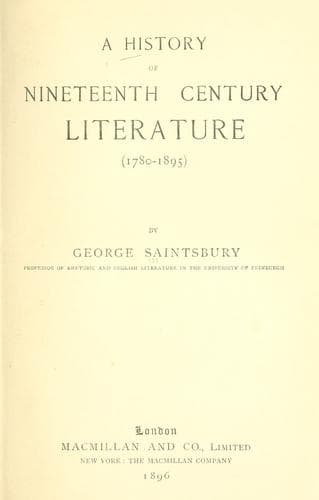
A History of Nineteenth Century Literature (1780-1895)Saintsbury, George
History
A History of Nineteenth Century Literature (1780-1895)
Saintsbury, George
English literature -- 19th century -- History and criticism
on Thames in August 1842, not yet fifty, but an utter wreck.
The collections of Maginn's work are anything but exhaustive, and the
work itself suffers from all the drawbacks, probable if not inevitable,
of work written in the intervals of carouse, at the last moment, for
ephemeral purposes. Yet it is instinct with a perhaps brighter genius
than the more accomplished productions of some much more famous men. The
_Homeric Ballads_, though they have been praised by some, are nearly
worthless; and the longer attempts in fiction are not happy. But
Maginn's shorter stories in _Blackwood_, especially the inimitable
"Story without a Tail," are charming; his more serious critical work,
especially that on Shakespeare, displays a remarkable combination of
wide reading, critical acumen, and sound sense; and his miscellanies in
prose and verse, especially the latter, are characterised by a mixture
of fantastic humour, adaptive wit, and rare but real pathos and melody,
which is the best note of the specially Irish mode. It must be said,
however, that Maginn is chiefly important to the literary historian as
the captain of a band of distinguished persons, and as in a way the link
between the journalism of the first and the journalism of the second
third of the century. A famous plate by Maclise, entitled "The
Fraserians," contains, seated round abundant bottles, with Maginn as
president, portraits (in order by "the way of the sun," and omitting
minor personages) of Irving, Gleig the Chaplain-General, Sir Egerton
Brydges, Allan Cunningham, Carlyle, Count D'Orsay, Brewster, Theodore
Hook, Lockhart, Crofton Croker of the Irish Fairy Tales, Jerdan, Dunlop
of the "History of Fiction," Gait, Hogg, Coleridge, Harrison Ainsworth,
Thackeray, Southey, and Barry Cornwall. It is improbable that all these
contributed at one time, and tolerably certain that some of them were
very sparing and infrequent contributors at any time, but the important
point is the juxtaposition of the generation which was departing and
the generation which was coming on--of Southey with Thackeray and of
Coleridge with Carlyle. Yet it will be noticed (and the point is of some
importance) that these new-comers are, at least the best of them, much
less merely periodical writers than those who came immediately before
them. In part no doubt this was accident; in part it was due to the
greater prominence which novels and serial works of other kinds were
beginning to assume; in part it may be to the fact that the great
increase in the number of magazines and newspapers had lowered their
individual dignity and perhaps their profitableness. But it is certain
that of the list just mentioned, Thackeray and Carlyle, of the
contemporary new generation of the _Edinburgh_ Macaulay, of the nascent
_Westminster_ Mill, and others, were not, like Jeffrey, like Sydney
Smith, like Wilson, and like De Quincey, content to write articles. They
aspired to write, and they did write, books; and, that being so, they
Public-domain text, read in full here on John Shaqi.
Reviews
Reviews
No reviews yet
Be the first to share your thoughts on this work.
Elsewhere in the archive
Join the Discussion
Join the discussion
Sign in to leave a comment or review.
Sign InorCreate an account