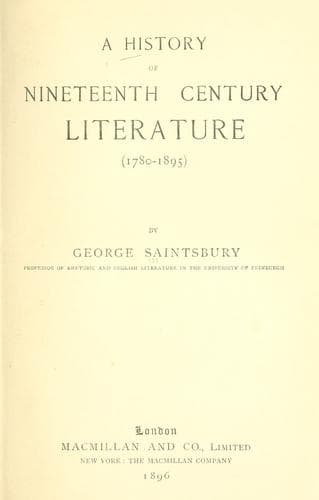
A History of Nineteenth Century Literature (1780-1895)Saintsbury, George
History
A History of Nineteenth Century Literature (1780-1895)
Saintsbury, George
English literature -- 19th century -- History and criticism
Calderon. Spanish gave way to Persian, and after some exercises
elsewhere the famous version, paraphrase, or whatever it is to be
called, of the Rubaiyat of Omar Khayyam appeared in 1859, to be much
altered in subsequent editions.
FitzGerald's works in the collected edition of 1889 fill three pretty
stout volumes, to which a considerable number of letters (he was first
of all and almost solely a letter-writer and translator) have been
added. In his prose (no disrespect being intended to _Euphranor_, a
dialogue Berkeleian in form and of great beauty, and other things) he
interests us doubly as a character and as a critic, for the letters
contain much criticism. Personally FitzGerald was a man of rather few
and not obtrusive, but deep and warm sympathies, slow to make new
friends but intensely tenacious of and affectionate towards the old,
with a very strong distaste for crowds and general society, and
undoubtedly somewhat of what the French call a _maniaque_, that is to
say, a slightly hypochondriac crotcheteer. These characteristics, which
make him interesting as a man, are still more interestingly reflected in
his criticism, which is often one-sided and unjust, sometimes crotchety
(as when he would not admit that even his beloved Alfred Tennyson had
ever been at his best since the collection of 1842), but often also
wonderfully delicate and true.
As a translator he stands almost alone, his peculiar virtue, noticeable
alike in his versions from the Spanish and Greek, being so capitally and
once for all illustrated in that of Omar Khayyam that in narrow space it
is not necessary to go beyond this. From the purist and pedantic point
of view FitzGerald, no doubt, is wildly unfaithful. He scarcely ever
renders word for word, and will insert, omit, alter, with perfect
freedom; yet the total effect is reproduced as perhaps no other
translator has ever reproduced it. Whether his version of the Rubaiyat,
with its sensuous fatalism, its ridicule of asceticism and renunciation,
and its bewildering kaleidoscope of mysticism that becomes materialist
and materialism that becomes mystical, has not indirectly had
influences, practical and literary, the results of which would have been
more abhorrent to FitzGerald than to almost any one else, may be
suggested. But the beauty of the poem as a poem is unmistakable and
altogether astounding. The melancholy richness of the rolling quatrain
with its unicorn rhymes, the quaint mixture of farce and solemnity,
passion and playfulness, the abundance of the imagery, the power of the
thought, the seduction of the rhetoric, make the poem actually, though
not original or English, one of the greatest of English poems.
Public-domain text, read in full here on John Shaqi.
Reviews
Reviews
No reviews yet
Be the first to share your thoughts on this work.
Elsewhere in the archive
Join the Discussion
Join the discussion
Sign in to leave a comment or review.
Sign InorCreate an account