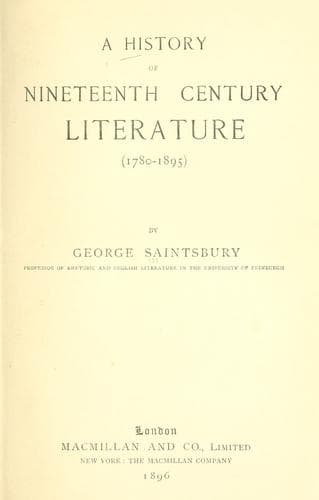
A History of Nineteenth Century Literature (1780-1895)Saintsbury, George
History
A History of Nineteenth Century Literature (1780-1895)
Saintsbury, George
English literature -- 19th century -- History and criticism
After the brilliant group of historians whose work illustrated the close
of the period covered by the preceding volume, it was some time before a
historical writer of the first rank again appeared in England; and there
were reasons for this. Not that, as in the case of purely creative
literature, in prose as in verse, there is any natural or actual lull
between different successive periods in this case; on the contrary the
writing of history is more likely to be stimulated by example, and
requires rather the utmost talent than positive genius, except in those
rare cases which, as in other departments, are not to be accounted for,
either in their presence or in their absence, by observation or
inference. But in the first place the greatest minds of the first
generation of which we have to take account, who were born about the
beginning of the third quarter of the eighteenth century, were, partly
by time and partly by chance, directed for the most part either into
poetry, or into politics, or into active life; and the five and twenty
years of the Revolutionary War in which they passed their manhood were
more likely to provide materials for history, than history itself.
Yet history, after the example given by Hume, by Robertson, and above
all by Gibbon, was not at all likely to cease, nor did some men of great
talents in other ways fail to betake themselves to it. Godwin was a
historian, and, considering his strong prejudices, the unkindness of
fortune (for history demands leisure almost as much as poetry), and some
defects of knowledge, not a contemptible historian in his way.
Mackintosh, intended for a philosopher, was a historian. Southey was a
very considerable historian, and master of one of the most admirable
historical styles on record. But he was signally unfortunate in having
that work of his which should have been most popular, the _History of
the Peninsular War_, pitted against another by a younger man of
professional competence, of actual experience, and of brilliant literary
powers, Sir William Napier (1786-1860). The literary value of these two
histories is more even than a generation which probably reads neither
much and has almost forgotten Southey is apt to imagine; and though
there is no doubt that the Poet Laureate was strongly prejudiced on the
Tory side, his competitor was even more partial and biassed against that
side. But the difference between the two books is the difference between
a task admirably performed, and performed to a certain extent _con
amore_, by a skilled practitioner in task-work, and the special effort
of one who was at once an enthusiast and an expert in his subject. It is
customary to call _Napier's History of the Peninsular War_ "the finest
military history in the English language," and so, perhaps, it is. The
famous description of the Battle of Albuera is only one of many showing
eloquence without any mere fine writing, and with the knowledge of the
soldier covering the artist's exaggeration.
Public-domain text, read in full here on John Shaqi.
Reviews
Reviews
No reviews yet
Be the first to share your thoughts on this work.
Elsewhere in the archive
Join the Discussion
Join the discussion
Sign in to leave a comment or review.
Sign InorCreate an account