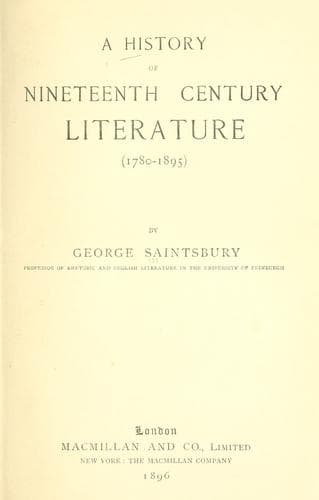
A History of Nineteenth Century Literature (1780-1895)Saintsbury, George
History
A History of Nineteenth Century Literature (1780-1895)
Saintsbury, George
English literature -- 19th century -- History and criticism
in the farmhouse she had to perform those of a servant as well as those
of a wife. Whatever other opinions may be passed on this episode of
Carlyle's life, which lasted from 1828 to 1834, there can be no doubt
that it "made" him. He did much positive work there, including all his
best purely literary essays. There he wrote _Sartor Resartus_, his
manifesto and proclamation, a wild book which, to its eternal honour,
_Fraser's Magazine_ accepted, probably under the influence of Lockhart,
with whom, strangely different as they were, Carlyle was always on good,
though never on intimate terms. There too was written great part of the
earlier form of the _French Revolution_. But the greatest thing that he
did at Craigenputtock was the thorough fermentation, clearing, and
settling of himself. When he went there, at nearly thirty-three, it was
more uncertain what would come of him than it is in the case of many a
man when he leaves the University at three and twenty. When he left it,
at close on his fortieth year, the drama of his literary life was
complete, though only a few lines of it were written.
That drama lasted in actual time for forty-seven years longer; and for
more than the first thirty of them fresh and ever fresh acts and scenes
carried it on. For the public his place was taken once and for all by
the _History of the French Revolution_, which, after alarming
vicissitudes (John Stuart Mill having borrowed the first volume in MS.
and lent it to a lady, to be destroyed by her housemaid), appeared in
1837. From at least that time Mrs. Carlyle's aspiration was fulfilled.
There were gain-sayers of course,--it may almost be said that genius
which is not gainsaid is not genius,--there were furious decriers of
style, temper, and so forth. But nine out of every ten men at least
whose opinion was worth taking knew that a new star of the first
magnitude had been added to English literature, however much they might
think its rays in some respects baleful.
Public-domain text, read in full here on John Shaqi.
Reviews
Reviews
No reviews yet
Be the first to share your thoughts on this work.
Elsewhere in the archive
Join the Discussion
Join the discussion
Sign in to leave a comment or review.
Sign InorCreate an account