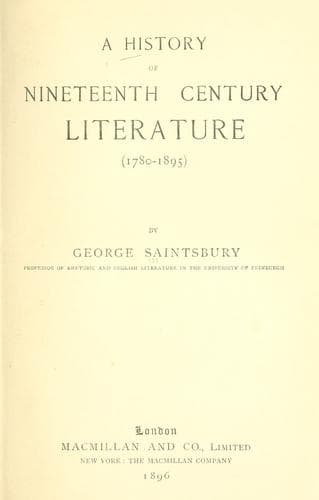
A History of Nineteenth Century Literature (1780-1895)Saintsbury, George
History
A History of Nineteenth Century Literature (1780-1895)
Saintsbury, George
English literature -- 19th century -- History and criticism
That this wave will pass may be asserted with a fulness and calmness of
assurance not to be surpassed in any similar case. Carlyle's influence
during a great part of the second and the whole of the third quarter of
this century was so enormous, his life was so prolonged, and the general
tone of public thought and public policy which has prevailed since some
time before his death has been so adverse to his temper, that the
reaction which is all but inevitable in all cases was certain to be
severe in his. And if this were a history of thought instead of being a
history of the verbal expression of thought, it would be possible and
interesting to explain this reaction, and to forecast the certain
rebound from it. As it is, however, we have to do with Carlyle as a man
of letters only; and if his position as the greatest English man of
letters of the century in prose be disputed, it will generally be found
that the opposition is due to some not strictly literary cause, while it
is certain that any competitor who is set up can be dislodged by a
fervent and well-equipped Carlylian without very much difficulty.
He has been classed here as a historian, and though the bulk of his work
is very great and its apparent variety considerable, it will be found
that history and her sister biography, even when his subjects bore an
appearance of difference, always in reality engaged his attention. His
three greatest books, containing more than half his work in bulk,--_The
French Revolution_, the _Cromwell_, and the _Frederick_,--are all openly
and avowedly historical. The _Schiller_ and the _Sterling_ are
biographies; the _Sartor Resartus_ a fantastic autobiography. Nearly all
the _Essays_, even those which are most literary in subject--all the
_Lectures on Heroes_, the greater part of _Past and Present_, _The Early
Kings of Norway_, the _John Knox_, are more or less plainly and strictly
historical or biographical. Even _Chartism_, the non-antique part of
_Past and Present_, and the _Latter-Day Pamphlets_, deal with politics
in the sense in which politics are the principal agent in making
history, regard them constantly and almost solely in their actual or
probable effect on the life-story of the nation, and to no small extent
of its individual members. Out of the historic relation of nation or
individual Carlyle would very rarely attempt to place, and hardly ever
succeeded in placing, any thing or person. He could not in the least
judge literature--of which he was so great a practitioner always, and
sometimes so great a judge--from the point of view of form: he would
have scorned to do so, and did scorn those who did so. His deficiencies
in abstract philosophy, whether political, theological, metaphysical,
or other, arise directly from this--that he could never contemplate any
of these things as abstract, but only in the common conduct of men
towards their fellows, towards themselves, and towards God. For Carlyle
Public-domain text, read in full here on John Shaqi.
Reviews
Reviews
No reviews yet
Be the first to share your thoughts on this work.
Elsewhere in the archive
Join the Discussion
Join the discussion
Sign in to leave a comment or review.
Sign InorCreate an account