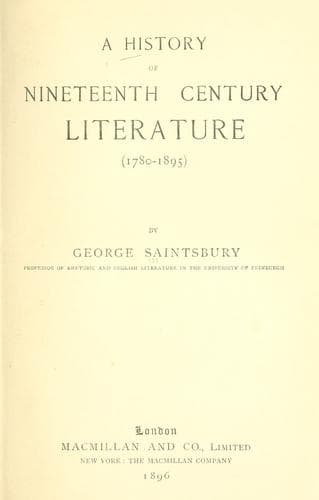
A History of Nineteenth Century Literature (1780-1895)Saintsbury, George
History
A History of Nineteenth Century Literature (1780-1895)
Saintsbury, George
English literature -- 19th century -- History and criticism
One of the greatest historians of the century, except for one curious
and unfortunate defect, and (without any drawback) one of the greatest
writers of English prose during that century, was James Anthony Froude,
who was born at Dartington near Totnes in 1818, on 23rd April
(Shakespeare's birthday and St. George's Day), and died in 1894 at the
Molt near Salcombe in his native county. Mr. Froude (the youngest son of
the Archdeacon of Totnes and the brother of Richard Hurrell Froude who
played so remarkable a part in the Oxford Movement, and of William
Froude the distinguished naval engineer) was a Westminster boy, and went
to Oriel College, Oxford, afterwards obtaining a fellowship at Exeter.
Like his elder brother he engaged in the Tractarian Movement, and was
specially under the influence of Newman, taking orders in 1844. The
great convulsion, however, of Newman's secession sent him, not as it
sent some with Newman, but like Mark Pattison and a few more, into
scepticism if not exactly negation, on all religious matters. He put his
change of opinions (he had previously written under the pseudonym of
"Zeta" a novel called _Shadows of the Clouds_) into a book entitled _The
Nemesis of Faith_, published in 1849, resigned his fellowship, gave up
or lost (to his great good fortune) a post which had been offered him in
Tasmania, and betook himself to literature, being very much, except in
point of style, under the influence of Carlyle. He wrote for _Fraser_,
the _Westminster_, and other periodicals; but was not content with
fugitive compositions, and soon planned a _History of England from the
Fall of Wolsey to the Defeat of the Armada_. The first volumes of this
appeared in 1856, and it was finished in 1869. Meanwhile Froude from
time to time collected his essays into volumes called _Short Studies_,
which contain some of his very best writing. His next large work was
_The English in Ireland_, which was published in three volumes
(1871-74). In 1874-75 Lord Carnarvon sent him on Government missions to
the Cape, an importation of a French practice into England which was not
very well justified by the particular instance. Between 1881 and 1884 he
was occupied as Carlyle's literary executor in issuing his biographical
remains. Later _Oceana_ and _The English in the West Indies_ contained
at once sketches of travel and political reflections; and in 1889 he
published an Irish historical romance, _The Two Chiefs of Dunboy_. He
was made Regius Professor of Modern History at Oxford in succession to
Mr. Freeman, and his two latest works, _Erasmus_, published just before,
and _English Seamen_ some months after his death, contain in part the
results of the appointment.
Public-domain text, read in full here on John Shaqi.
Reviews
Reviews
No reviews yet
Be the first to share your thoughts on this work.
Elsewhere in the archive
Join the Discussion
Join the discussion
Sign in to leave a comment or review.
Sign InorCreate an account