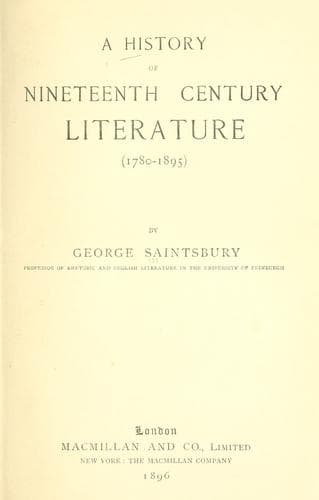
A History of Nineteenth Century Literature (1780-1895)Saintsbury, George
History
A History of Nineteenth Century Literature (1780-1895)
Saintsbury, George
English literature -- 19th century -- History and criticism
Thirdly, and still rising in the scale of incontestability, though even
so contested, I believe, by some, is the merit of style. I have
sometimes doubted whether Mr. Froude at his best has any superior among
the prose writers of the last half of this century. His is not a
catching style; and in particular it does not perhaps impress itself
upon green tastes. It has neither the popular and slightly brusque
appeal of Macaulay or Kinglake, nor the unique magnificence of Mr.
Ruskin, nor the fretted and iridescent delicacy of some other writers.
It must be frankly confessed that, the bulk of his work being very great
and his industry not being untiring, it is unequal, and sometimes not
above (it is never below) good journey-work. But at its best it is of a
simply wonderful attraction--simply in the pure sense, for it is never
very ornate, and does not proceed in point of "tricks" much beyond the
best varieties of the latest Georgian form. That strange quality of
"liveliness" which has been noticed in reference to its author's view of
history, animates it throughout. It is never flat; never merely
popular; never merely scholarly; never merely "precious" and eccentric.
And at its very best it is excelled by no style in this century, and
approached by few in this or any other, as a perfect harmony of
unpretentious music, adjusted to the matter that it conveys, and
lingering on the ear that it reaches.
NOTE.--As examples of the almost enforced omissions referred
to in the text may be mentioned earlier Archdeacon Coxe, the
biographer of Marlborough and the historian of the House of
Austria; later, Finlay (1799-1875), the valiant successor of
Gibbon, and the chronicler of the obscure and thankless
fortunes of the country called Greece, after it had ceased
to be living. Professor Sir J. R. Seeley, Kingsley's
successor at Cambridge (1834-94), equally distinguished in
his professional business, and as a lay theologian in a
sense rather extra-orthodox than unorthodox; and Sir John
Stirling-Maxwell, no mean historian either in the general
sense or in the special department of Art. It is open to any
one to contend that each and all of these as well deserve
notice as not a few dealt with above; yet if they were
admitted others still could hardly be excluded.
CHAPTER VI
THE SECOND POETICAL PERIOD
Public-domain text, read in full here on John Shaqi.
Reviews
Reviews
No reviews yet
Be the first to share your thoughts on this work.
Elsewhere in the archive
Join the Discussion
Join the discussion
Sign in to leave a comment or review.
Sign InorCreate an account