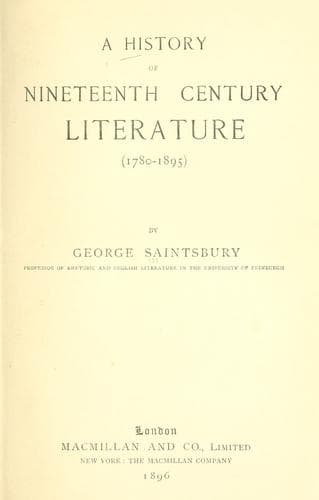
A History of Nineteenth Century Literature (1780-1895)Saintsbury, George
History
A History of Nineteenth Century Literature (1780-1895)
Saintsbury, George
English literature -- 19th century -- History and criticism
The later instalments of the poem--some of them, as has been said, very
much later, but still so closely connected as to be best noticed
here--were of somewhat less even excellence. It was an inevitable, but
certainly an unfortunate thing, that the poet republished the
magnificent early fragment above noticed in a setting which, fine as it
would have been for any one else, was inferior to this work of the very
best time. Some of the lighter passages, as in _Gareth and Lynette_,
showed less grace than their forerunners in _The Princess_; and in
_Pelleas and Ettarre_ and _Balin and Balan_ the poet sometimes seemed to
be attempting alien moods which younger poets than himself had made
their own. But the best passages of some of these later Idylls, notably
those of _The Holy Grail_ and _The Last Tournament_, were among the
finest, not merely of the book, but of the poet. Nowhere has he caught
the real, the best, spirit of the legends he followed more happily;
nowhere has he written more magnificent verse than in Percivale's
account of his constantly baffled quest and of Lancelot's visit to the
"enchanted towers of Carbonek."
Far earlier than these, _Enoch Arden_ and its companion poems were
something more of a return to the scheme of the earlier books--no very
long single composition, but a medley of blank verse pieces and lyrics,
the former partly expansions of the scheme of the earlier "English
Idyll," the latter various and generally beautiful; one or two, such as
"In the Valley of Cauterets," of the most beautiful. Here, too, were
some interesting translations, with the dialect pieces above referred
to; and all the later volumes, except those containing the plays,
preserved this mixed manner. Their contents are too numerous for many to
be mentioned here. Only in the _Ballads and Other Poems_ was something
like a distinctly new note struck in the two splendid patriotic pieces
on "The Last Fight of the _Revenge_" and the "Defence of Lucknow,"
which, even more than the poet's earlier "Charge of the Light Brigade,"
deserve the title of the best English war-songs since Campbell; in
"Rizpah," an idyll of a sterner and more tragic kind than anything he
had previously attempted; and in the "Voyage of Maeldune," this last in
some respects the most interesting of the whole. For the marvellous
power which great poets possess of melting, of "founding," so to speak,
minor styles and kinds of poetry to their own image, while not losing a
certain character of the original, has never been shown better than
here. Attention had, even before the date of this poem, been drawn to
the peculiar character of early Celtic poetry,---not the adulterated
style of Ossian, but the genuine method of the old Irish singers. And,
since, a whole band of young and very clever writers have set
themselves, with a mixture of political and poetical enthusiasm, the
task of reviving these notes if possible. They have rarely succeeded in
Public-domain text, read in full here on John Shaqi.
Reviews
Reviews
No reviews yet
Be the first to share your thoughts on this work.
Elsewhere in the archive
Join the Discussion
Join the discussion
Sign in to leave a comment or review.
Sign InorCreate an account