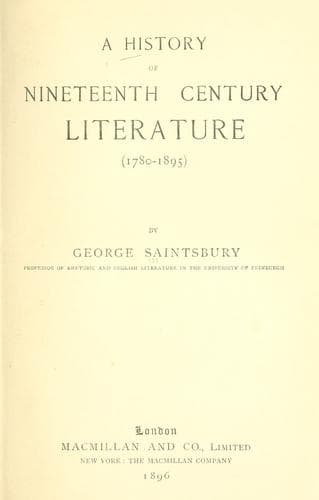
A History of Nineteenth Century Literature (1780-1895)Saintsbury, George
History
A History of Nineteenth Century Literature (1780-1895)
Saintsbury, George
English literature -- 19th century -- History and criticism
But it would argue gross unfairness in an advocate, and gross
incompetence in a critic, to let it be supposed that these popular
attractions were the only ones that Mrs. Browning possessed. Despite and
besides the faults which will be presently noticed, and which,
critically speaking, are very grave faults, she had poetical merits of a
very high order. Her metrical faculty, though constantly flawed and
imperfect, was very original and full of musical variety. Although her
choice of words could by no means always be commended, her supply of
them was extraordinary. Before her imprisonment in sick-rooms she had
pored on nature with the eagerest and most observant eye, and that
imprisonment itself only deepened the intensity of her remembered
nature-worship. Her pathos, if it sometimes over-flowed into gush, was
quite unquestionable in sincerity and most powerful in appeal; her
sentiment was always pure and generous; and it is most curious to see
how in the noble directness of such a piece as "Lord Walter's Wife," not
only her little faults of _sensiblerie_, but her errors of diction, are
burnt and smelted out by the fire of the expressed impression. Her
verse-pictures--for instance those in the "Vision of Poets"--vie, in
beauty if not in clearness of composition and definition, with
Tennyson's own. The Romantic pieces already glanced at, obnoxious and
obvious as are their defects, unite the pathos and the picturesqueness
just assigned to her in a most remarkable manner. And when, especially
in the Sonnet, she consented to undergo the limitations of a form which
almost automatically restrained her voluble facility, the effect was
often simply of the first order. The exquisite "Sonnets from the
Portuguese" (which are not from the Portuguese, and are understood to
have been addressed to Mr. Browning), especially that glorious one
beginning--
If thou wilt love me, let it be for naught
Except for love's sake only--
(which is not far below Shakespeare's or the great thing which was
published as Drayton's), rank with the noblest efforts of the 16th-17th
century in this exquisite form. And if this, instead of having to
conform to the requirements of a connected history, were a separate
study of Mrs. Browning, it would be necessary to mention scores of
separate pieces full of varied beauty.
Public-domain text, read in full here on John Shaqi.
Reviews
Reviews
No reviews yet
Be the first to share your thoughts on this work.
Elsewhere in the archive
Join the Discussion
Join the discussion
Sign in to leave a comment or review.
Sign InorCreate an account