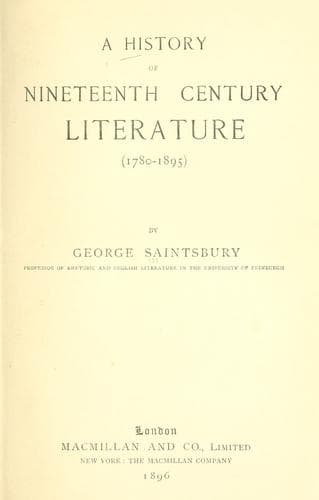
A History of Nineteenth Century Literature (1780-1895)Saintsbury, George
History
A History of Nineteenth Century Literature (1780-1895)
Saintsbury, George
English literature -- 19th century -- History and criticism
But all these things, and others put together, are not so fatal as her
extraordinary dulness of ear in the matter of rhyme. She endeavoured to
defend her practice in this respect in the correspondence with Horne,
but it is absolutely indefensible. What is known as assonance, that is
to say, vowel rhyme only, as in Old French and in Spanish, is not in
itself objectionable, though it is questionably suited to English. But
Mrs. Browning's eccentricities do not as a rule, though they sometimes
do, lie in the direction of assonance. They are simply bad and vulgar
rhymes--rhymes which set the teeth on edge. Thus, when she rhymes
"palace" and "chalice," "evermore" and "emperor," "Onora" and "o'er
her," or, most appalling of all, "mountain" and "daunting," it is
impossible not to remember with a shudder that every omnibus conductor
does shout "Pal_lis_," that the common Cockney would pronounce it
"Onorer," that the vulgar ear is deaf to the difference between _ore_
and _or_, and that it is possible to find persons not always of the
costermonger class who would make of "mountain" something very like
"mauunting." In other words, Mrs. Browning deliberately, or lazily, or
for want of ear, admits false pronunciation to save her the trouble of
an exact rhyme. Nay, more, despite her Greek, she will rhyme "idyll" to
"middle," and "pyramidal" to "idle," though nothing can be longer than
the _i_ in the first case, and nothing shorter than the _i_ in the
second. The positive anguish which such hideous false notes as these
must cause to any one with a delicate ear, the maddening interruption to
the delight of these really beautiful pieces of poetry, cannot be
over-estimated. It is fair to say that among the later fruit of her
poetical tree there are fewer of these Dead Sea apples,--her husband,
who, though audacious, was not vulgar in his rhymes, may have taught her
better. But to her earlier, more spontaneous, and more characteristic
verse they are a most terrible drawback, such as no other English poet
exhibits or suffers.
Public-domain text, read in full here on John Shaqi.
Reviews
Reviews
No reviews yet
Be the first to share your thoughts on this work.
Elsewhere in the archive
Join the Discussion
Join the discussion
Sign in to leave a comment or review.
Sign InorCreate an account