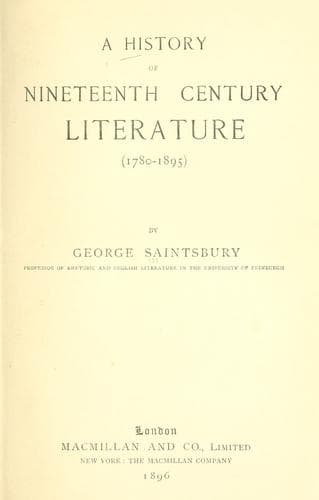
A History of Nineteenth Century Literature (1780-1895)Saintsbury, George
History
A History of Nineteenth Century Literature (1780-1895)
Saintsbury, George
English literature -- 19th century -- History and criticism
It was never widely popular, for O'Shaughnessy pushed the fancy of the
Prae-Raphaelites for a dreamy remoteness to its very furthest, and the
charge (usually an uncritical one, but usually also explaining with a
certain justice a poet's unpopularity) of "lack of human interest" was
brought against him. Sometimes, too, either of deliberate conviction or
through corrupt following of others, he indulged in expressions of
opinion about matters on which the poet is not called upon to express
any, in a manner which was always unnecessary and sometimes offensive.
But judged as a poet he has the _unum necessarium_, the individual note
of song. Like Keats, he was not quite individual--there are echoes,
especially of Edgar Poe, in him. But the genuine and authentic
contribution is sufficient, and is of the most unmistakable kind. In the
first book "Exile," "A Neglected Heart," "Bisclavaret," "The Fountain of
Tears," "Barcarolle," make a new mixture of the fair and strange in
meaning, a new valuation of the eternal possibilities of language in
sound. _Music and Moonlight_--O'Shaughnessy was one of the few poets who
have been devoted to music--is almost more remote, and even less
popularly beautiful; but the opening "Ode," some of the lyrics in the
title poem (such as "Once in a hundred years"), the song "Has summer
come without the rose," and not a few others, renew for those who can
receive it the strange attraction, the attraction most happily hinted by
the very title of this book itself, which O'Shaughnessy could exercise.
That there was not a little that is morbid in him--as perhaps in the
school generally--sane criticism cannot deny. But though it is as unwise
as it is unsafe to prefer morbidness for itself or to give it too great
way, there are undoubted charms in it, and O'Shaughnessy could give
poetical form to these as few others could. Two of his own lines--
Oh! exquisite malady of the soul,
How hast thou marred me--
put the thing well. Those who have once tasted his poetry return, and
probably, though they are never likely to be numerous, always when they
have once tasted will return, to the visions and the melodies--
Of a dreamer who slumbers,
And a singer who sings no more.
Public-domain text, read in full here on John Shaqi.
Reviews
Reviews
No reviews yet
Be the first to share your thoughts on this work.
Elsewhere in the archive
Join the Discussion
Join the discussion
Sign in to leave a comment or review.
Sign InorCreate an account