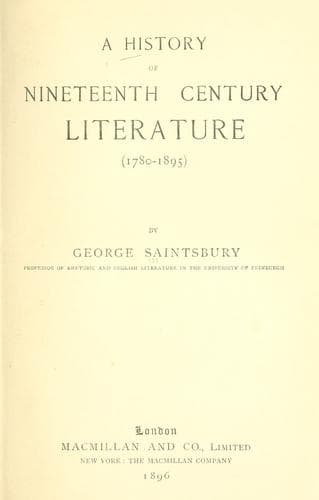
A History of Nineteenth Century Literature (1780-1895)Saintsbury, George
History
A History of Nineteenth Century Literature (1780-1895)
Saintsbury, George
English literature -- 19th century -- History and criticism
The _Lays of the Scottish Cavaliers_, on which his chief serious claim
must rest, is an interesting book, if hardly a great one. The style is
modelled with extreme closeness upon that of Scott, which even Sir
Walter, with all his originality and genius, had not been able always to
preserve from flatness. In Aytoun's hands the flats are too frequent,
though they are relieved and broken at times by really splendid bursts,
the best of which perhaps are "The Island of the Scots" and "The Heart
of the Bruce." For Aytoun's poetic vein, except in the lighter kinds,
was of no very great strength; and an ardent patriotism, a genuine and
gallant devotion to the Tory cause, and a keen appreciation of the
chivalrous and romantic, did not always suffice to supply the want of
actual inspiration.
If it had been true, as is commonly said, that the before-mentioned
_Firmilian_ killed the so-called Spasmodic School, Aytoun's failure to
attain the upper regions of poetry would have been a just judgment; for
the persons whom he satirised, though less clever and humorous, were
undoubtedly more poetical than himself. But nothing is ever killed in
this way, and as a matter of fact the Spasmodic School of the early
fifties was little more than one of the periodical outbursts of poetic
velleity, more genuine than vigorous and more audacious than organic,
which are constantly witnessed. It is, as usual, not very easy to find
out who were the supposed scholars in this school. Mr. P. H. Bailey, the
author of _Festus_, who still survives, is sometimes classed with them;
but the chief members are admitted to have been Sydney Dobell and
Alexander Smith, both remarkable persons, both failures of something
which might in each case have been a considerable poet, and both
illustrating the "second middle" period of the poetry of the century
which corresponds to that illustrated earlier by Darley, Horne, and
Beddoes.
Public-domain text, read in full here on John Shaqi.
Reviews
Reviews
No reviews yet
Be the first to share your thoughts on this work.
Elsewhere in the archive
Join the Discussion
Join the discussion
Sign in to leave a comment or review.
Sign InorCreate an account