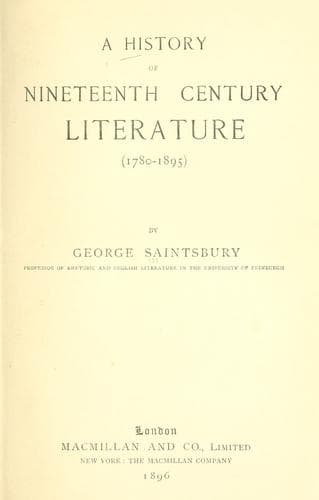
A History of Nineteenth Century Literature (1780-1895)Saintsbury, George
History
A History of Nineteenth Century Literature (1780-1895)
Saintsbury, George
English literature -- 19th century -- History and criticism
is in existence in a collected form has been printed or reprinted since.
A more full account of the appearance of Coleridge's work than is
desirable or indeed possible in most cases here has been given, because
it is important to convey some idea of the astonishingly piecemeal
fashion in which it reached the world. To those who have studied the
author's life of opium-eating; of constant wandering from place to
place; of impecuniousness so utter that, after all the painstaking of
the modern biographer, and after full allowance for the ravens who seem
always to have been ready to feed him, it is a mystery how he escaped
the workhouse; of endless schemes and endless non-performance--it is
only a wonder that anything of Coleridge's ever reached the public
except in newspaper columns. As it was, while his most ambitiously
planned books were never written at all, most of those which did reach
the press were years in getting through it; and Southey, on one
occasion, after waiting fifteen months for the conclusion of a
contribution of Coleridge's to _Omniana_, had to cancel the sheet in
despair. The collection, after many years, by Mr. Ernest Coleridge of
his grandfather's letters has by no means completely removed the mystery
which hangs over Coleridge's life and character. We see a little more,
but we do not see the whole; and we are still unable to understand what
strange impediments there were to the junction of the two ends of power
and performance. A rigid judge might almost say, that if friends had not
been so kind, fate had been kinder, and that instead of helping they
hindered, just as a child who is never allowed to tumble will never
learn to walk.
The enormous tolerance of friends, however, which alone enabled him to
produce anything, was justified by the astonishing genius to which its
possessor gave so unfair a chance. As a thinker, although the evidence
is too imperfect to justify very dogmatic conclusions, the opinion of
the best authorities, from which there is little reason for differing,
is that Coleridge was much more stimulating than intrinsically valuable.
His _Aids to Reflection_, his most systematic work, is disappointing;
and, with _The Friend_ and the rest, is principally valuable as
exhibiting and inculcating an attitude of mind in which the use of logic
is not, as in most eighteenth century philosophers, destructive, but is
made to consist with a wide license for the employment of imagination
and faith. He borrowed a great deal from the Germans, and he at least
sometimes forgot that he had borrowed a great deal from our own older
writers.
Public-domain text, read in full here on John Shaqi.
Reviews
Reviews
No reviews yet
Be the first to share your thoughts on this work.
Elsewhere in the archive
Join the Discussion
Join the discussion
Sign in to leave a comment or review.
Sign InorCreate an account