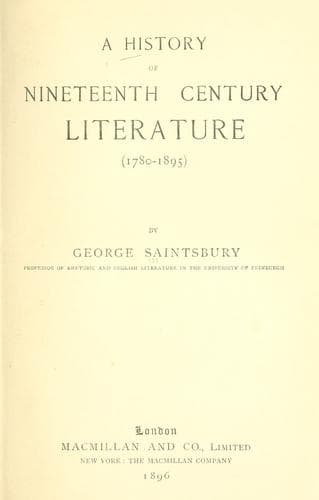
A History of Nineteenth Century Literature (1780-1895)Saintsbury, George
History
A History of Nineteenth Century Literature (1780-1895)
Saintsbury, George
English literature -- 19th century -- History and criticism
Robert Southey, the third of this curiously dissimilar trio whom partly
chance and partly choice have bound together for all time, was born at
Bristol on 12th August 1774. His father was only a linen-draper, and a
very unprosperous one; but the Southeys were a respectable family,
entitled to arms, and possessed of considerable landed property in
Somerset, some of which was left away from the poet by unfriendly uncles
to strangers, while more escaped him by a flaw in the entail. His
mother's family, the Hills, were in much better circumstances than his
father, and like the other two Lake Poets he was singularly lucky in
finding helpers. First his mother's brother the Rev. Herbert Hill,
chaplain to the English factory at Lisbon, sent him to Westminster,
where he did very well and made invaluable friends, but lost the regular
advancement to Christ Church owing to the wrath of the head-master Dr.
Vincent at an article which Southey had contributed to a school
magazine, the _Flagellant_. He was in fact expelled; but the gravest
consequences of expulsion from a public school of the first rank did not
fall upon him, and he matriculated without objection at Balliol in 1793.
His college, however, which was then distinguished for loose living and
intellectual dulness, was not congenial to him; and developing extreme
opinions in politics and religion, he decided that he could not take
orders, and left without even taking a degree. His disgrace with his own
friends was completed by his engaging in the Pantisocratic scheme, and
by his attachment to Edith Fricker, a penniless girl (though not at all
a "milliner at Bath") whose sisters became Mrs. Coleridge and Mrs.
Lovell. And when the ever-charitable Hill invited him to Portugal he
married Miss Fricker the very day before he started. After a residence
at Lisbon, in which he laid the foundation of his unrivalled
acquaintance with Peninsular history and literature, he returned and
lived with his wife at various places, nominally studying for the law,
which he liked not better but worse than the Church. After divers
vicissitudes, including a fresh visit (this time not as a bachelor) to
Portugal, and an experience of official work as secretary to Corry the
Irish Chancellor of the Exchequer, he at last, at the age of thirty,
established himself at Greta Hall, close to Keswick, where Coleridge had
already taken up his abode. This, as well as much else in his career,
was made possible by the rare generosity of his friend of school-days
and all days, Charles Wynn, brother of the then Sir Watkin, and later a
pretty well known politician, who on coming of age gave him an annuity
of L160 a year. This in 1807 he relinquished on receiving a government
pension of practically the same amount. The Laureateship in 1813 brought
him less than another hundred; but many years afterwards Sir Robert
Peel, in 1835, after offering a baronetcy, put his declining years out
Public-domain text, read in full here on John Shaqi.
Reviews
Reviews
No reviews yet
Be the first to share your thoughts on this work.
Elsewhere in the archive
Join the Discussion
Join the discussion
Sign in to leave a comment or review.
Sign InorCreate an account