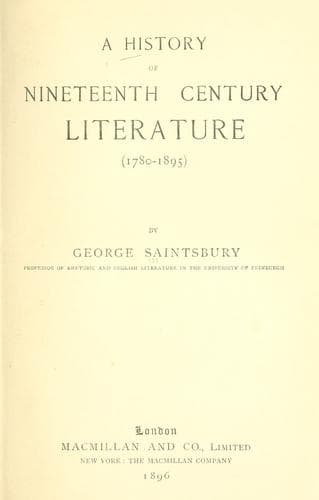
A History of Nineteenth Century Literature (1780-1895)Saintsbury, George
History
A History of Nineteenth Century Literature (1780-1895)
Saintsbury, George
English literature -- 19th century -- History and criticism
Certain things about Southey are uncontested and uncontestable. The
uprightness and beauty of his character, his wonderful helpfulness to
others, and the uncomplaining way in which he bore what was almost
poverty,--for, high as was his reputation, his receipts were never a
tithe of the rewards not merely of Scott or Byron or Tom Moore, but of
much lesser men--are not more generally acknowledged than the singular
and pervading excellence of his English prose style, the robustness of
his literary genius, and his unique devotion to literature. But when we
leave these accepted things he becomes more difficult if not less
interesting. He himself had not the slightest doubt that he was a great
poet, and would be recognised as such by posterity, though with a proud
humility he reconciled himself to temporary lack of vogue. This might be
set down to an egotistic delusion. But such an easy explanation is
negatived by even a slight comparison of the opinions of his greatest
contemporaries. It is somewhat staggering to find that Scott, the
greatest Tory man of letters who had strong political sympathies, and
Fox, the greatest Whig politician who had keen literary tastes, enjoyed
his long poems enthusiastically. But it may be said that the eighteenth
century leaven which was so strong in each, and which is also noticeable
in Southey, conciliated them. What then are we to say of Macaulay, a
much younger man, a violent political opponent of Southey, and a by no
means indiscriminate lover of verse, who, admitting that he doubted
whether Southey's long poems would be read after half a century, had no
doubt that if read they would be admired? And what are we to say of the
avowals of admiration wrung as it were from Byron, who succeeded in
working himself up, from personal, political, and literary motives
combined, into a frantic hatred of Southey, lampooned him in print, sent
him a challenge (which luckily was not delivered) in private, and was
what the late Mr. Mark Pattison would have called "his Satan"?
Public-domain text, read in full here on John Shaqi.
Reviews
Reviews
No reviews yet
Be the first to share your thoughts on this work.
Elsewhere in the archive
Join the Discussion
Join the discussion
Sign in to leave a comment or review.
Sign InorCreate an account