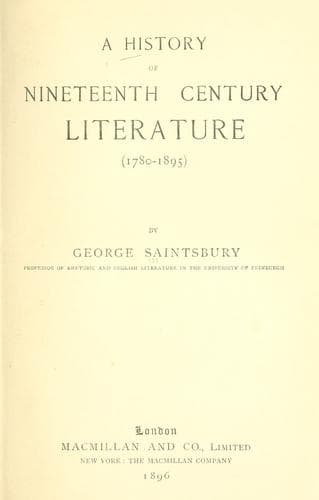
A History of Nineteenth Century Literature (1780-1895)Saintsbury, George
History
A History of Nineteenth Century Literature (1780-1895)
Saintsbury, George
English literature -- 19th century -- History and criticism
He thus acquired great knowledge of his fatherland; while (for he was,
if not exactly a scholar, the most omnivorous of readers) he was also
acquiring great knowledge of books. And it ought not to be omitted that
Edinburgh, in addition to the literary and professional society which
made it then and afterwards so famous, was still to no small extent the
headquarters of the Scotch nobility, and that Scott, long before his
books made him famous, was familiar with society of every rank. His
first love affair did not run smooth, and he seems never to have
entirely forgotten the object of it, who is identified (on somewhat more
solid grounds than in the case of other novelists) with more than one of
his heroines. But he consoled himself to a certain extent with a young
lady half French, half English, Miss Charlotte Carpenter or Charpentier,
whom he met at Gilsland and married at Carlisle on Christmas Eve 1797.
Scott was an active member of the yeomanry as well as a barrister, an
enthusiastic student of German as well as a sportsman; and the book of
translations (from Buerger) above referred to appeared in 1796. But he
did nothing important till after the beginning of the present century,
when the starting of the _Edinburgh Review_ and some other things
brought him forward; though he showed what he could do by contributing
two ballads, "Glenfinlas" and "The Eve of St. John," to a collection of
terror-pieces started by Monk Lewis, and added Goethe's _Goetz von
Berlichingen_ to his translations. He had become in 1799 independent,
though not rich, by being appointed Sheriff of Selkirkshire.
His beginnings as an author proper were connected, as was all his
subsequent career, partly for good but more for ill, with a school
friendship he had early formed for two brothers named Ballantyne at
Kelso. He induced James, the elder, to start a printing business at
Edinburgh, and unfortunately he entered into a secret partnership with
this firm, which never did him much good, which caused him infinite
trouble, and which finally ruined him. But into this complicated and
still much debated business it is impossible to enter here. James
Ballantyne printed the _Border Minstrelsy_, which appeared in 1802,--a
book ranking with Percy's _Reliques_ in its influence on the form and
matter of subsequent poetry,--and then Scott at last undertook original
work of magnitude. His task was _The Lay of the Last Minstrel_,
published in 1805. It may almost be said that from that day to his death
he was the foremost--he was certainly, with the exception of Byron, the
most popular--man of letters in Great Britain. His next poems--_Marmion_
(1808) and _The Lady of the Lake_ (1810)--brought him fame and money
such as no English poet had gained before; and though Byron's
following--for following it was--for the time eclipsed his master, the
latter's _Rokeby, The Lord of the Isles_, and others, would have been
triumphs for any one else.
Public-domain text, read in full here on John Shaqi.
Reviews
Reviews
No reviews yet
Be the first to share your thoughts on this work.
Elsewhere in the archive
Join the Discussion
Join the discussion
Sign in to leave a comment or review.
Sign InorCreate an account