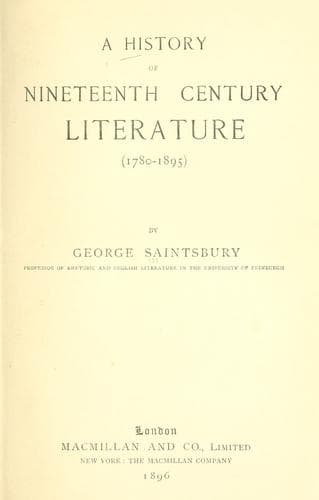
A History of Nineteenth Century Literature (1780-1895)Saintsbury, George
History
A History of Nineteenth Century Literature (1780-1895)
Saintsbury, George
English literature -- 19th century -- History and criticism
Yet it seems to me impossible, on any just theory of poetry or of
literature, to rank him low as a poet. He can afford to take his trial
under more than one statute. To those who say that all depends on the
subject, or that the handling and arrangement of the subject are, if not
everything, yet something to be ranked far above mere detached beauties,
he can produce not merely the first long narrative poems in English,
which for more than a century had honestly enthralled and fixed popular
taste, but some of the very few long narrative poems which deserve to do
so. Wordsworth, in a characteristic note on the _White Doe of Rylstone_,
contrasts, with oblique depreciation of Scott, that poem and its famous
predecessors in the style across the border; but he omits to notice one
point of difference--that in Scott the _story_ interests, and in himself
it does not. For the belated "classical" criticism of the _Edinburgh
Review_, which thought the story of the _Last Minstrel_ childish, and
that of _Marmion_ not much better, it may have been at least consistent
to undervalue these poems. But the assumptions of that criticism no
longer pass muster. On the other hand, to those who pin their poetical
faith on "patches," the great mass of Scott's poetical work presents
examples of certainly no common beauty. The set pieces of the larger
poems, the Melrose description in _The Lay_, the battle in _Marmion_,
the Fiery Cross in the _Lady of the Lake_, are indeed inferior in this
respect to the mere snatches which the author scattered about his
novels, some of which, especially the famous "Proud Maisie," have a
beauty not inferior to that of the best things of his greatest
contemporaries. And in swinging and dashing lyric, again, Scott can hold
his own with the best, if indeed "the best" can hold _their_ own in this
particular division with "Lochinvar" and "Bonnie Dundee," with Elspeth's
ballad in the _Antiquary_, and the White Lady's comfortable words to
poor Father Philip.
Public-domain text, read in full here on John Shaqi.
Reviews
Reviews
No reviews yet
Be the first to share your thoughts on this work.
Elsewhere in the archive
Join the Discussion
Join the discussion
Sign in to leave a comment or review.
Sign InorCreate an account