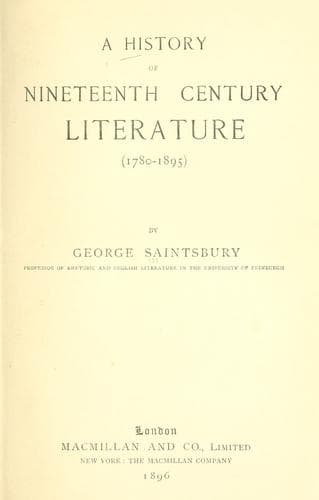
A History of Nineteenth Century Literature (1780-1895)Saintsbury, George
History
A History of Nineteenth Century Literature (1780-1895)
Saintsbury, George
English literature -- 19th century -- History and criticism
common with the English aristocracy, and hence, in 1805, he proceeded to
Trinity College, Cambridge. He spent about the usual time there, but
took no degree, and while he was still an undergraduate printed his
_Hours of Idleness_, first called _Juvenilia_. It appeared publicly in
March 1807, and a year later was the subject of a criticism, rather
excessive than unjust, in the _Edinburgh Review_. Byron, who had plenty
of pluck, and who all his life long inclined in his heart to the Popian
school, spent a considerable time upon a verse-answer, _English Bards
and Scotch Reviewers_, in which he ran amuck generally, but displayed
ability which it was hopeless to seek in his first production. Then he
went abroad, and the excitement of his sojourn in the countries round
the Mediterranean for the next two years not only aroused, but finally
determined and almost fully developed, his genius.
On his return home he took his seat and went into society with the
success likely to attend an extremely handsome young man of
twenty-three, with a vague reputation both for ability and naughtiness,
a fairly old title, and something of an estate. But his position as a
"lion" was not thoroughly asserted till the publication, in February
1812, of _Childe Harold_, which with some difficulty he had been induced
by his friend Dallas, his publisher Murray, and the critic Gifford to
put before some frigid and trivial _Hints from Horace_. Over _Childe
Harold_ the English public went simply mad, buying seven editions in
five weeks; and during the next three years Byron produced, in rapid
succession, _The Giaour_, _The Bride of Abydos_, _The Corsair_, _Lara_,
_The Siege of Corinth_, and _Hebrew Melodies_. He could hardly write
fast enough for the public to buy. Then the day after New Year's Day
1814, he married Miss Milbanke, a great heiress, a future baroness in
her own right, and handsome after a fashion, but of a cold, prim, and
reserved disposition, as well as of a very unforgiving temper. It
probably did not surprise any one who knew the pair when, a year later,
they separated for ever.
Public-domain text, read in full here on John Shaqi.
Reviews
Reviews
No reviews yet
Be the first to share your thoughts on this work.
Elsewhere in the archive
Join the Discussion
Join the discussion
Sign in to leave a comment or review.
Sign InorCreate an account