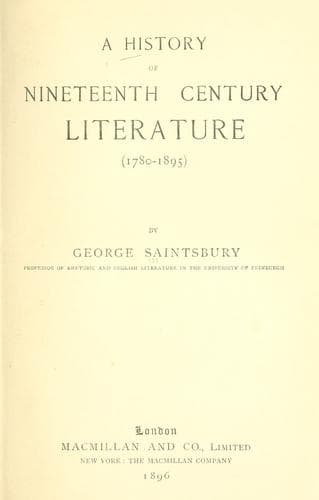
A History of Nineteenth Century Literature (1780-1895)Saintsbury, George
History
A History of Nineteenth Century Literature (1780-1895)
Saintsbury, George
English literature -- 19th century -- History and criticism
I have read Byron again and again; I have sometimes, by reading
Byron only and putting a strong constraint upon myself, got nearly into
the mood to enjoy him. But let eye or ear once catch sight or sound of
real poetry, and the enchantment vanishes.
Attention has already been called to the fact that Byron, though
generally ranking with the poets who have been placed before him in this
chapter as a leader in the nineteenth century renaissance of poetry, was
a direct scholar of Scott, and in point of age represented, if not a new
generation, a second division of the old. This was still more the case
in point of age, and almost infinitely more so in point of quality, as
regards Shelley and Keats. There was nothing really new in Byron; there
was only a great personal force directing itself, half involuntarily and
more than half because of personal lack of initiative, into contemporary
ways. The other two poets just mentioned were really new powers. They
took some colour from their elders; but they added more than they took,
and they would unquestionably have been great figures at any time of
English literature and history. Scott had little or no influence on
them, and Wordsworth not much; but they were rather close to Coleridge,
and they owed something to a poet of much less genius than his or than
their own--Leigh Hunt.
Percy Bysshe Shelley, the elder of the two, was Byron's junior by four
years, and was born at Field Place in Sussex in August 1792. He was the
heir of a very respectable and ancient though not very distinguished
family of the squirearchy; and he had every advantage of education,
being sent to Eton in 1804, and to University College, Oxford, six years
later. The unconquerable unconventionality of his character and his
literary tastes had shown themselves while he was still a schoolboy, and
in the last year of his Etonian and the first of his Oxonian residence
he published two of the most absurd novels of the most absurd novel kind
that ever appeared, _Zastrozzi_ and _St. Irvyne_, imitations of Monk
Lewis. He also in the same year collaborated in two volumes of verse,
_The Wandering Jew_ (partly represented by _Queen Mab_), and "_Poems_ by
Victor and Cazire" (which has vindicated the existence of reviewers by
surviving only in its reviews, all copies having mysteriously perished).
His stay at Oxford was not long; for having, in conjunction with a
clever but rather worthless friend, Thomas Jefferson Hogg (afterwards
his biographer), issued a pamphlet on "The Necessity of Atheism" and
sent it to the heads of colleges, he was, by a much greater necessity,
expelled from University on 25th March 1811. Later in the same year he
married Harriet Westbrook, a pretty and lively girl of sixteen, who had
been a school-fellow of his sister's, but came from the lower middle
class. His apologists have said that Harriet threw herself at his head,
and that Shelley explained to her that she or he might depart when
either pleased.
Public-domain text, read in full here on John Shaqi.
Reviews
Reviews
No reviews yet
Be the first to share your thoughts on this work.
Elsewhere in the archive
Join the Discussion
Join the discussion
Sign in to leave a comment or review.
Sign InorCreate an account