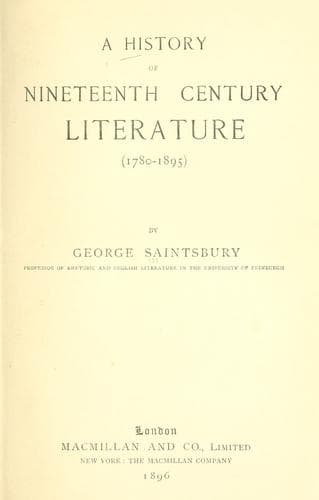
A History of Nineteenth Century Literature (1780-1895)Saintsbury, George
History
A History of Nineteenth Century Literature (1780-1895)
Saintsbury, George
English literature -- 19th century -- History and criticism
Rogers had the good luck to publish his best piece at a time when the
general and popular level of English poetry was at the lowest point it
has reached since the sixteenth century, and to be for many years
afterwards a rich and rather hospitable man, the acquaintance if not
exactly the friend of most men of letters, of considerable influence in
political and general society, and master of an excessively sharp
tongue. A useful friend and a dangerous enemy, it was simpler to court
or to let him alone than to attack him, and his fame was derived from
pieces too different from any work of the actual generation to give them
much umbrage. It may be questioned whether Rogers ever wrote a single
line of poetry. But he wrote some polished and pleasant verse, which was
vigorous by the side of Hayley and "correct" by the side of Keats. In
literature he has very little interest; in literary history he has some.
_Felix opportunitate_ in the same way, but a far greater poet, was
Thomas Campbell, who, like Rogers, was a Whig, like him belonged rather
to the classical than to the romantic school in style if not in choice
of subject, and like him had the good luck to obtain, by a poem with a
title very similar to that of Rogers' masterpiece, a high reputation at
a time when there was very little poetry put before the public. Campbell
was not nearly so old a man as Rogers, and was even the junior of the
Lake poets and Scott, having been born at Glasgow on the 27th July 1777.
His father was a real Campbell, and as a merchant had at one time been
of some fortune; but the American War had impoverished him, and the poet
was born to comparative indigence. He did, however, well at the college
of his native city, and on leaving it took a tutorship in Mull. His
_Pleasures of Hope_ was published in 1799 and was extremely popular, nor
after it had its author much difficulty in following literature. He was
never exactly rich, but pensions, legacies, editorships, high prices for
his not extensive poetical work, and higher for certain exercises in
prose book-making which are now almost forgotten, maintained him very
comfortably. Indeed, of the many recorded ingratitudes of authors to
publishers, Campbell's celebrated health to Napoleon because "he shot a
bookseller" is one of the most ungrateful. In the last year of the
eighteenth century he went to Germany, and was present at (or in the
close neighbourhood of) the battle of Hohenlinden. This he afterwards
celebrated in really immortal verse, which, with "Ye Mariners of
England" and the "Battle of the Baltic," represents his greatest
achievement. In 1809 he published _Gertrude of Wyoming_, a short-long
poem of respectable _technique_ and graceful sentiment. In 1824 appeared
a volume of poems, of which the chief, _Theodric_ (not as it is
constantly misspelled _Theodoric_), is bad; and in 1842 another, of
which the chief, _The Pilgrim of Glencoe_, is worse. He died in 1844 at
Public-domain text, read in full here on John Shaqi.
Reviews
Reviews
No reviews yet
Be the first to share your thoughts on this work.
Elsewhere in the archive
Join the Discussion
Join the discussion
Sign in to leave a comment or review.
Sign InorCreate an account