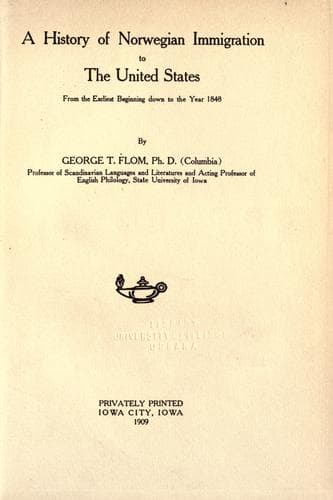
A History of Norwegian Immigration to the United States: From the Earliest Beginning down to the Year 1848Flom, George T. (George Tobias)
History
A History of Norwegian Immigration to the United States: From the Earliest Beginning down to the Year 1848
Flom, George T. (George Tobias)
Norwegians -- United States
[206] Syver Gaarder's daughter, Barbro, married Martin Johnson
(Nederhaugen) in 1855. Dr. J. S. Johnson, of Minneapolis,
is their oldest son; other children are: Ben Johnson,
Orfordville, Wisconsin; Mrs. Rev. Langseth, Glendorado,
Minn.; Mrs. Rev. L. Njus, McIntosh, Minn.; Mrs. Strömseth,
living on the homestead; Mandy Johnson.
CHAPTER XXVI
_Economic Conditions of Immigrants. Cost of Passage.
Course of the Journey. Duration
of the Journey._
In discussing the causes of emigration, we have found that economic
factors entered extensively into operation. It was the desire for
material betterment that prompted a very large proportion of Norwegian
emigrants to leave the land of their fathers. The first five decades
of Norwegian emigration was a period in which the battle for existence
among the Norwegian peasant and the common man was none too easy.
Unfavorable economic conditions, the oppressive methods of the
larger land owners, frequent crop failure, often reduced the lesser
farmers into a condition of impoverishment. Even wealthy families
found themselves burdened by debts from which the future seemed to
offer little hope of relief. By the law of primogeniture the oldest
son inherited the estate. The sons of men of means, therefore, were
financially often no better situated than the cotter's son, and were
often forced to seek their fortune beyond the native village or
district. These considerations will make clear first that the great
majority of Norwegian emigrants to the United States were at the time
of emigration of small means; they were often very poor indeed. Their
wealth lay in the ability and the will to carve their way in a land
of greater promise. Their wealth lay also in their thrift, in their
ideals, and the moral fiber of their race. Many of those who have
succeeded best in their adopted country came here well-nigh penniless.
To them poverty was no longer a curse when the path of opportunity lay
before them. But the above considerations will also have indicated
that Norwegian immigrants of that early period were not always of the
poor classes even though they came here with little or nothing. Later
Norwegian immigration has, it is true, generally been from among the
impecunious. But in that early period, especially 1835 to 1865, a very
large number of the immigrants came from families which general or
special conditions had suddenly so reduced to conditions which became
to them intolerable. And it was the hope which America held out which
inspired them with the will to seek there the independence now no
longer theirs. We have already met with the evidence of this in such
families as Hovland (1835), Nattestad (1837), Aadland (1837), Aasland
(1838), Gravdal (1839), Stabæk (1839), Gitle Danielson (1839), Luraas
(1839), Unde (1839), Heg (1840), Gaarder (1843-49), Nils Haugen (1846),
and many others.
Public-domain text, read in full here on John Shaqi.
Reviews
Reviews
No reviews yet
Be the first to share your thoughts on this work.
Elsewhere in the archive
Join the Discussion
Join the discussion
Sign in to leave a comment or review.
Sign InorCreate an account