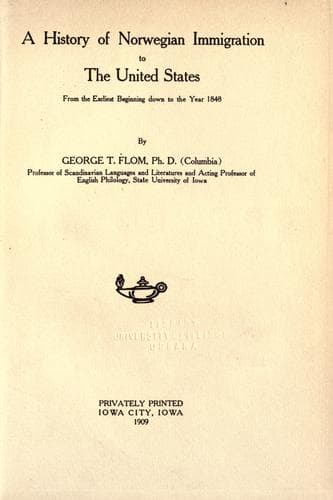
A History of Norwegian Immigration to the United States: From the Earliest Beginning down to the Year 1848Flom, George T. (George Tobias)
History
A History of Norwegian Immigration to the United States: From the Earliest Beginning down to the Year 1848
Flom, George T. (George Tobias)
Norwegians -- United States
[208] The regulations varying with different ships, _Juno_, which
brought the first party from Inner Sogn in 1844, did not
accept any passenger who had not provided himself with food
supply for twelve weeks.
[209] i. e. $47. R. B. Anderson's _First Chapter_, page 313.
The inland journey, generally in the early days made by canal boat,
varied greatly in cost, often amounting to as much as fourteen dollars
to Milwaukee or Chicago. But the additional toll inland frequently
made the inland journey much more expensive than was the ocean voyage.
One pioneer, writing of this later, says that his whole journey cost
him ninety dollars.[210] In the fifties the inland journey was made by
railroad; the railroad ticket from Quebec to Chicago or Milwaukee was
eight dollars.
[210] In American money, of which less than half for the ocean voyage.
The course of the journey has been incidentally indicated above.
During the first years it was usually by way of Gothenburg, sometimes
via Hamburg, not infrequently by way of Havre. The starting point was
Stavanger, Bergen, Skien, Drammen, Porsgrund and Christiania, later
other ports. New York was most often the place of landing, but not
infrequently Boston, in isolated instances, Fall River, Philadelphia
and New Orleans. After 1850 sail-ships plied extensively between
Scandinavian ports and Quebec.[211] The inland journey from New York
went by steamboat to Albany, thence by canal boat to Buffalo, a
distance of three hundred and fifty miles, which usually took twelve
days but often over two weeks.[212] From Buffalo the journey went
by steamboat over the Great Lakes to Milwaukee and Chicago, after
1842 usually to Milwaukee. Those who took the Quebec route after 1850
were then brought to St. Levi by the railroad company's steamboats,
whence they went by rail to Chicago or Milwaukee,[213] a journey which
generally took four or five days,[214] over a distance of 1020 miles.
Milwaukee-bound passengers were often shipped from Port Huron by way
of Lakes Huron and Michigan or were taken by rail from Detroit across
Michigan to Grand Haven, thence by steamboat across Lake Michigan to
Milwaukee.[215] The latter was of course the shorter and the favored
route for immigrants whose destination was Wisconsin, Northern Iowa, or
Minnesota. Immigrants who landed in Boston usually went by steamboat
thence to New York and from the regular inland route as given above.
[211] Of the trials and the hardships of the ocean voyage in
the thirties, forties and fifties, we can to-day have no
conception. It would, however, fall outside the scope
of this work to discuss that here. I may refer the
reader to a well-written article by H. Cock Jensen in
_Nordmandsforbundet_, December, 1907, pages 53-66. See also
Holand's article, pages 56-60.
[212] A good account of the character of this journey is given by
Holand, pages 65-74.
Public-domain text, read in full here on John Shaqi.
Reviews
Reviews
No reviews yet
Be the first to share your thoughts on this work.
Elsewhere in the archive
Join the Discussion
Join the discussion
Sign in to leave a comment or review.
Sign InorCreate an account