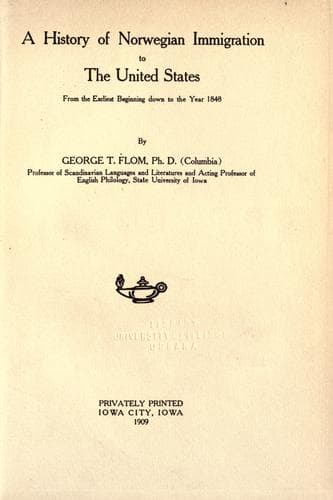
A History of Norwegian Immigration to the United States: From the Earliest Beginning down to the Year 1848Flom, George T. (George Tobias)
History
A History of Norwegian Immigration to the United States: From the Earliest Beginning down to the Year 1848
Flom, George T. (George Tobias)
Norwegians -- United States
Mrs. Svartskuren, who is now eighty-seven years old and quite feeble,
has, since 1902, lived at Leeds, North Dakota, with a son, Carl,
he having sold the homestead after the father's death, and moved to
Viroqua, Wisconsin, and later to Leeds. Peder Svartskuren was among
the founders of the East Koshkonong Church; he was a man of strong
character, who enjoyed in large degree the love and the respect of his
fellows.
The Town of Sumner did not receive many accessions from Norway. In
the same interview Svartskuren says: "There are now twelve Norwegian
families, besides six Swedish families. The rest are German and
English."
The Town of Oakland, Jefferson County, also received a few settlers at
this early period. The earliest arrival there was, I believe, Tollef
Bækhus and wife, Aasild; they came to Koshkonong in 1843 and located
two miles east of the village of Rockdale. They were from Laurdal
Parish, in Upper Telemarken, had been married in 1838, and had two
children when they came to this country. Tollef Bækhus died in 1897,
the widow lived until 1906, being ninety years old at the time of her
death. A son, John Bækhus, now owns the homestead.[264]
[264] They had twelve children in all.
In Chapter XVIII above we gave an account of the founding of the
Koshkonong Settlement, which began in the townships of Christiana,
Deerfield and Albion, in 1840-41. We spoke briefly of the founders and
of those who came and joined the three groups of pathfinders in the
following year. In Chapter XXVIII a similar record has been given of
the events which led to the settling of the Town of Pleasant Spring by
four families in 1843, and by others in the following year. We have
also observed how the towns of Dunkirk and Cottage Grove became settled
in 1843, and that Dunn received its first Norwegian settlers in 1844.
The towns of Sumner and Oakland, in Jefferson County, in the eastern
extremity of Koshkonong Prairie also received a small contingent
of Norwegian immigrant settlers in 1842 and 1843 respectively. The
original nucleus and the subsequent expansions of the settlement, east,
west and north, are thereby indicated.
In four years after its inception, the settlement covered an area
of about fifteen square miles. But the settlers lived, for the most
part, far apart; geographically they had made ample provisions for a
great settlement in this garden spot of Wisconsin. While there were
as yet (in 1843) not more than a hundred and fifty individuals in the
settlement, there was room for thousands more without going beyond
the boundary as already laid out. The beginning made in a few years
was remarkable, but the growth in the years immediately following was
even more wonderful. For a time Koshkonong was the destination of
four-fifths of those who emigrated from Norway.
Public-domain text, read in full here on John Shaqi.
Reviews
Reviews
No reviews yet
Be the first to share your thoughts on this work.
Elsewhere in the archive
Join the Discussion
Join the discussion
Sign in to leave a comment or review.
Sign InorCreate an account