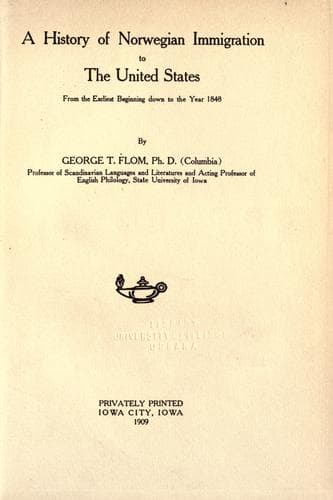
A History of Norwegian Immigration to the United States: From the Earliest Beginning down to the Year 1848 — John Shaqi
A History of Norwegian Immigration to the United States: From the Earliest Beginning down to the Year 1848Flom, George T. (George Tobias)
History
A History of Norwegian Immigration to the United States: From the Earliest Beginning down to the Year 1848
Flom, George T. (George Tobias)
Norwegians -- United States
The emigrants of the preceding year (1844) ... wrote home ... and
told of the fertility of the soil, the cheap prices of land and of
good wages. In a letter which I received from Iver Hove, he writes
that there they raise thirty-five bushels of wheat per acre, and
the grass is so thick that one can easily cut enough in one day for
winter feed for the cow. Such things fell to our liking, and many
looked forward with eager longing to the distant West, which was
pictured as the Eden that loving Providence had destined as a home
for the workingman of Norway, so oppressed with cares and want.
Of those here cited, Nattestad was from Numedal, Luraas from
Telemarken, Menes from Sogn, while Sandsberg came from Ryfylke. But
the conditions were the same also in other provinces. In 1844, Hans
C. Tollefsrude and wife emigrated from Land. Of the cause of his
emigrating and that of early emigration from Land in general, his son
Christian H. Tollefsrude of Rolfe, Iowa, writes me:
The causes were, no personal means and no prospect even securing a
home in their native district, Torpen, Nordre Land (letter of July
27, 1904).
Rev. Abraham Jacobson of Decorah, Iowa, a pioneer himself, writes:
Reasons for emigrating were mostly economic, very few if any
religious.... Wages here were at the very least double that in
Norway, and generally much more than that.
Of the emigration from Ringsaker, I may cite Simon Simerson of Belmond,
Iowa:
The causes were economic. In the case of my parents, they came
here to create the home that they saw no chance of securing in the
mother country. (Letter of Oct. 12, 1904.)
Similar evidence might be adduced for other districts and for all the
older settlements throughout the Northwest. At a meeting held at the
home of Ole O. Flom in Stoughton, Wisconsin, on July twenty-eighth,
1908, when the present writer read a paper on "Early Norwegian
Immigration," testimony to the same effect was given by old pioneers
there present. There is no need of further multiplying the evidence.
A highly developed spirit of independence has always been a dominant
element in the Scandinavian character,--I have reference here
particularly to his desire for personal independence, that is,
independence in his condition in life. Nothing is so repugnant to him
as indebtedness to others and dependence on others. An able-bodied
Scandinavian who was a burden to his fellows was well-nigh unheard
of. By the right of primogeniture the paternal estate would go to the
oldest son. The families being frequently large, the owning of a home
was to a great many practically an impossibility under wage conditions
as they were in the North in the first half and more of the preceding
century.
Public-domain text, read in full here on John Shaqi.
Reviews
Reviews
No reviews yet
Be the first to share your thoughts on this work.
Join the Discussion
Join the discussion
Sign in to leave a comment or review.
Sign InorCreate an account