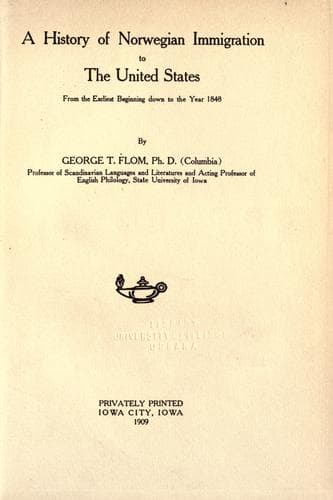
A History of Norwegian Immigration to the United States: From the Earliest Beginning down to the Year 1848Flom, George T. (George Tobias)
History
A History of Norwegian Immigration to the United States: From the Earliest Beginning down to the Year 1848
Flom, George T. (George Tobias)
Norwegians -- United States
The sailing of _Enigheden_ may be regarded as a continuation of the
movement in Stavanger county, which was given such an impetus by Knud
Slogvig's return in 1835. Other immigrants continued to come from this
region in subsequent years, but the autumn of 1837 inaugurates a change
in the course of the movement to a more northerly region, Hardanger,
Voss, and Bergen, for a period, contributing a large share to the now
rapidly increasing numbers of emigrants.
CHAPTER X
_The Year 1837. The Sailing of Aegir._
The influence of Gjert Hovland in this new trend in the immigration
should be noted. South Bergenhus now became the scene of immigration
activity. At the same time it is to be observed that Hardanger had
contributed its quota of immigrants in the exodus of 1836. The return
of Knud Slogvig was noised far beyond the County of Stavanger. Among
those who travelled long distances to see and talk with Slogvig and
get personal affirmation of what reports had told of America, was Nils
P. Langeland, a school teacher from Samnanger, one of the emigrants of
1837. Similarly Knud Langeland relates in _Nordmaendene i Amerika_,
page twenty-three, how he paid a visit to Slogvig in the winter of
1836, and received from him assurance of what he had read[71] about
the New World. Knud Langeland gives a most interesting account of how
his interest in America became aroused; though a personal experience,
it is undoubtedly typical of that of many a young man in Bergen and
surrounding region at this time. As a document in immigration history,
it is sufficiently significant to warrant quoting in considerable part.
He says:
Public-domain text, read in full here on John Shaqi.
Reviews
Reviews
No reviews yet
Be the first to share your thoughts on this work.
Elsewhere in the archive
Join the Discussion
Join the discussion
Sign in to leave a comment or review.
Sign InorCreate an account