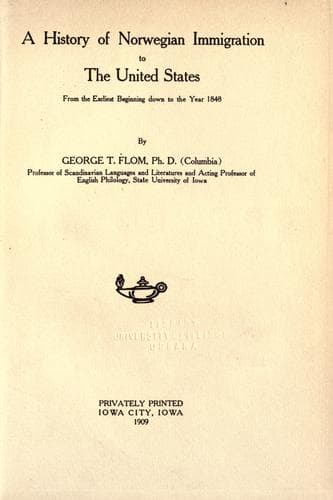
A History of Norwegian Immigration to the United States: From the Earliest Beginning down to the Year 1848Flom, George T. (George Tobias)
History
A History of Norwegian Immigration to the United States: From the Earliest Beginning down to the Year 1848
Flom, George T. (George Tobias)
Norwegians -- United States
That same fall Gisle Halland married Margit Knudsdatter Nösterud
from Rallaug Parish, Numedal, being obliged to go as far south as
Rockford, Illinois, to get the ceremony performed. Their oldest child,
Kristine, born in the fall of 1840, was the first white child born in
that township. Gravdal, speaking of those days, says: "When I located
in this region, the whole country to the west was a desert. I do not
know whether there lived white people anywhere between my home and the
Mississippi. The same was also the case toward the north; however,
about seven miles west (east?) from my home two Yankees had settled in
the wilderness. The Indians were still lords of these regions. They
often visited us in our houses, but they were always friendly and
courteous. We were never molested by the wild son of the desert. There
was at this time an abundance of game; we saw stags in large herds,
and prairie chickens literally swarmed." There seem to have been no
fresh accessions of settlers until the spring of 1841. Then Lars H.
Skavlem arrived and located on section eleven. Gullik Knudson Laugen
also came at the same time, and not long after several Americans moved
in. Both Skavlem and Knudson had come to America in 1839, having been
members of Nattestad's party. Skavlem had, in the interval, lived on
Jefferson Prairie. Gullik Knudson had remained in Chicago, as had also
Gunnul Stordok, securing work there,[90] as did also two girls from
Numedal, to whom they were engaged in Norway. These two couples were
married the following winter, and, having saved some money from their
small earnings, they decided to buy a home somewhere in the Norwegian
settlement in Rock County. Knudson relates: "I walked about several
days to find a location for a home, and at last came to a place on
the verge of a prairie, where a rushing spring of water poured out of
the ground. Here I decided to build and live, and I called the place
_Springen_ (the spring). The land about was like a desert; barring the
four Norwegians who had come before me, there were no settlers. Toward
the west one had to travel twenty-two miles to find white people. It
was fortunate that there was an abundance of game, for what we secured
by hunting was the sustenance on which we chiefly relied during the
winter." He tells how, with the first fall of snow, he and another[91]
walked on _skis_ to Beloit to buy flour, and how the tracks left in the
snow by the skis had aroused considerable wonder and speculation among
the Americans about there, who afterwards discovered the tracks, and
that it became the subject of extensive discussion as to what unknown
monster could have left such tracks. Beloit, he says, consisted then of
a mill, a hotel, two stores, and a few laborers' cottages.
[90] His wages were from six to ten dollars a week.
[91] Whom we now know to have been Hellik Glaim.
Public-domain text, read in full here on John Shaqi.
Reviews
Reviews
No reviews yet
Be the first to share your thoughts on this work.
Elsewhere in the archive
Join the Discussion
Join the discussion
Sign in to leave a comment or review.
Sign InorCreate an account