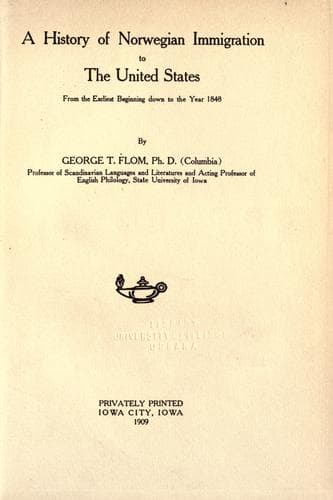
A History of Norwegian Immigration to the United States: From the Earliest Beginning down to the Year 1848Flom, George T. (George Tobias)
History
A History of Norwegian Immigration to the United States: From the Earliest Beginning down to the Year 1848
Flom, George T. (George Tobias)
Norwegians -- United States
Sören Backe seems to have been a man whose generosity was as remarkable
as his lack of business ability. His father, a man of considerable
wealth, had supplied his son generously with funds upon his departure
for America. Sören Backe evidently loaned money very liberally to
those of his countrymen who were in need, and there were many of these
here as in all pioneer communities. It is said that when his funds
were used up he made a journey to Norway for more money. With this he
purchased land, which he let out on easy terms to new comers from
Norway. It was Johannesen who had charge of these transactions in which
it seems Even Heg was a partner with Backe. Johannesen is described as
a devout christian, a zealous adherent of the Haugian tendency, and in
every way a noble character. As we have seen, the settlement developed
rapidly, and it continued to grow for many years. Backe and Johannesen
then joined partnership and started a store; for this purpose an
Indian mound was excavated, the walls were sided with boards, and this
structure, which was partly underground, served as store, living room
and kitchen combined. Their stock of goods was shipped from Milwaukee,
itself then only a village of one or two stores, a hotel and half a
dozen pioneer cabins. Backe and Johannesen continued their business
together for about three years when Johannesen fell ill and died (in
1845). That same year Backe returned to Norway and settled on his
father's farm Valle, in Lier, near Drammen.
Even Heg was a leading spirit in the settlement in Norway and
surrounding townships during his life-time. Much has been written
about him and I shall not here repeat the eulogies elsewhere voiced
in his honor. After Johannesen's death it was Heg upon whom the
settlers in the early days of the colony leaned for advice and it was
Even Heg to whom every new arrival from Norway to the colony came for
help and counsel. His hospitality and his resourcefulness in the aid
of his compatriots was boundless. Heg's barn, where large parties
of immigrants were received every summer, and in which they were
permitted freely to make their home during the first weeks after the
long and arduous journey, is famed throughout many an early settlement
in Wisconsin, Iowa and Minnesota. The log cabins of the settlers
were too small to afford the necessary quarters for the numbers that
continuously flocked in, and the large barn was a boon for which they
were truly grateful. For a time Racine County became the objective
point of most of the immigrants from Norway, a distinction which
however it was soon to share with the still more famous Koshkonong
Prairie in Dane County, Wisconsin.
Public-domain text, read in full here on John Shaqi.
Reviews
Reviews
No reviews yet
Be the first to share your thoughts on this work.
Elsewhere in the archive
Join the Discussion
Join the discussion
Sign in to leave a comment or review.
Sign InorCreate an account