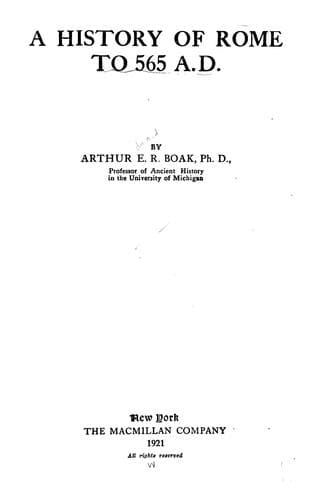
A History of Rome to 565 A. D.Boak, Arthur E. R. (Arthur Edward Romilly)
Philosophy
A History of Rome to 565 A. D.
Boak, Arthur E. R. (Arthur Edward Romilly)
Rome -- History
*An era of internal peace.* With Nerva begins a period in the history of
the principate that is characterized by amicable relations between the
princeps and the Senate. The basis of this concord was the agreement by
the successive emperors to acknowledge the freedom of senators from the
imperial jurisdiction. There was no longer any question of an active
participation by the Senate as a whole in the administration, nevertheless
it continued to exercise its influence through the official posts reserved
for senators. In addition to the establishment of these harmonious
relations, the peaceful succession of a number of able rulers who were
designated by adoption and association in the powers of the principate has
caused this epoch to be regarded as one of the happiest periods of Roman
history.
Nerva died in January, 98 A. D., after a rule of less than two years, and
was succeeded by Trajan, who assumed office at Cologne.
*Trajan’s character and policy.* Trajan was a native of the Roman colony
of Italica in Spain, and the first provincial to attain the principate.
His accession is evidence not only for the degree of romanization in the
Spanish provinces but also for the decline of the dominance of the
strictly Italian element within the empire and the transformation of the
Italian into an imperial nobility of wealth and office. The new princeps
was above all things a soldier, and the desire for military glory was his
chief weakness. At the same time he was an energetic and conscientious
administrator, and showed a personal interest in the welfare of Italy and
the provinces, as we see from his correspondence with the younger Pliny,
governor of Bithynia in 111–113 A. D. He respected the rights of the
Senate and repeated Nerva’s oath not to condemn one of that body to death.
Public-domain text, read in full here on John Shaqi.
Reviews
Reviews
No reviews yet
Be the first to share your thoughts on this work.
Elsewhere in the archive
Join the Discussion
Join the discussion
Sign in to leave a comment or review.
Sign InorCreate an account