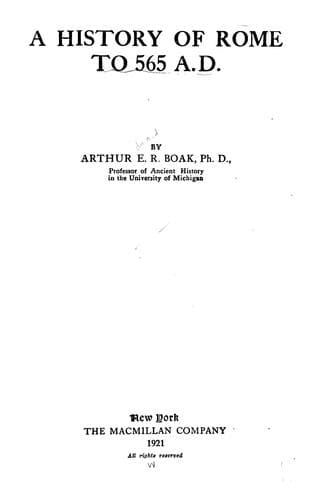
A History of Rome to 565 A. D.Boak, Arthur E. R. (Arthur Edward Romilly)
Philosophy
A History of Rome to 565 A. D.
Boak, Arthur E. R. (Arthur Edward Romilly)
Rome -- History
*II. The aerarium.* Augustus had left to the Senate the control of the
public treasury, the _aerarium_, which was maintained by revenues from the
senatorial provinces and Italy. But when the princeps came to assume
control of those branches of the administration the expense of which was
defrayed by the _aerarium_, it was inevitable that the treasury itself
should pass in some degree under his supervision. And so in 44 A. D. the
princeps began to designate two quaestors to be in charge of the treasury
for a three-year period. Under Nero the place of these quaestors was taken
by two prefects appointed in the same manner but from among the
ex-praetors. The importance of the _aerarium_ declined in proportion as
its revenues passed into the hands of the ministers of the princeps, until
in the period between Septimius Severus and Diocletian it sank to the
position of a municipal chest for the city of Rome.
*III. The senatorial provinces.* In the early principate the senatorial
provinces were administered by appointees of the Senate, all of whom now
bore the title of proconsul, assisted as in former days by quaestors.
However, only the proconsul of Africa was at the same time commander of a
provincial garrison, and his command was transferred to the imperial
governor of Numidia by Caligula. Even in the time of Augustus the imperial
procurators had appeared in the senatorial provinces in charge of the
revenues which were at the disposal of the princeps, and, before the close
of the third century they were in complete control of the financial
administration of these provinces. But long before this, by the opening of
the second century, the princeps had usurped the Senate’s privilege of
appointing the proconsuls. The result was that by the close of the
principate all the provinces without distinction were equally under
imperial control.
*Restriction of Senate’s elective powers.* It was Tiberius who transferred
to the Senate the electoral functions of the Assembly but he, as Augustus
before him, limited the Senate’s freedom of action by the recommendation
of imperial candidates for the lower magistracies. From the time of Nero
the consulship also was regularly filled by nominees of the emperors. The
custom of appointing several successive consular pairs in the course of
each year, each pair functioning for two or four months, greatly weakened
the influence of the consulate, while it enabled the emperors to gratify
the ambitions of a larger number of candidates for that office.
Public-domain text, read in full here on John Shaqi.
Reviews
Reviews
No reviews yet
Be the first to share your thoughts on this work.
Elsewhere in the archive
Join the Discussion
Join the discussion
Sign in to leave a comment or review.
Sign InorCreate an account