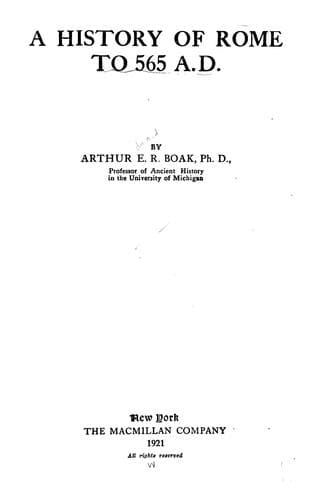
A History of Rome to 565 A. D.Boak, Arthur E. R. (Arthur Edward Romilly)
Philosophy
A History of Rome to 565 A. D.
Boak, Arthur E. R. (Arthur Edward Romilly)
Rome -- History
The imperial government of Rome had crushed out all vestiges of national
loyalty among the peoples it had absorbed, and had failed to create any
political institutions which would have permitted the provincials, as
such, to have participated in the government of the empire. With the
gradual decline of municipal autonomy the great mass of the provincials
were deprived of the last traces of an independent political life. The
provincial councils established for the maintenance of the imperial cult
did indeed occasionally voice the complaints of the provincials but never
acquired active political powers. And that the Roman administration proved
a heavy burden is attested by the numerous complaints against the weight
of taxation and the necessity which many emperors felt of remitting the
arrears of tribute.
V. MUNICIPAL LIFE
The Roman empire was at bottom an aggregate of locally self-governing
communities, which served as units for conscription, taxation and
jurisdiction. They were held together by the army and the civil service,
and were united by the bonds of a common Graeco-Roman civilization. These
municipalities were of two general types, the Hellenic in the East and the
Latin in the West.
The Hellenic municipalities were developments from the _poleis_, or
city-states, which existed prior to the Roman conquest in Greece and the
Hellenized areas of Asia and Africa. Municipal towns organized in these
areas subsequent to the Roman occupation were of the same type. Their
language of government, as well as of general intercourse, was Greek. The
characteristic political institutions of the Hellenic municipalities were
a popular assembly, a council or _boule_ and annual magistrates. The
assembly had the power to initiate legislation; the council and
magistrates were elected by it or were chosen by lot. But even under the
Roman republic these democratic institutions were considerably modified in
the interests of the wealthier classes. Timocratic constitutions were
established with required property qualifications for citizenship and for
the council and offices. The principate saw a further development along
the same lines. The assemblies lost their right to initiate legislation, a
power which passed to the magistrates, while the council tended to become
a body of ex-magistrates who held their seats for life. However, in spite
of this approximation to the Latin type, the Greek official terminology
remained unchanged throughout the first three centuries A. D.
Public-domain text, read in full here on John Shaqi.
Reviews
Reviews
No reviews yet
Be the first to share your thoughts on this work.
Elsewhere in the archive
Join the Discussion
Join the discussion
Sign in to leave a comment or review.
Sign InorCreate an account