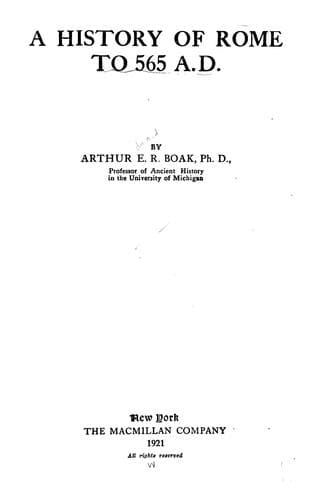
A History of Rome to 565 A. D.Boak, Arthur E. R. (Arthur Edward Romilly)
Philosophy
A History of Rome to 565 A. D.
Boak, Arthur E. R. (Arthur Edward Romilly)
Rome -- History
The members of the _curia_ were called _decuriones_, and were usually one
hundred in number. They comprised those who had held some local
magistracy, and others having the requisite property qualification who
were enrolled directly (_adlecti_) in the council. The council supervised
the work of the magistrates and really directed the municipal
administration. As in early Rome, so in the municipalities the people were
grouped in _curiae_, which were the voting units in the local assembly or
_comitia_. This assembly elected the magistrates and had legislative
powers corresponding to those of the Roman assemblies. However, in the
course of the second century A. D. these legislative powers passed into
the hands of the council, whose decrees became the sole form of municipal
legislation.
*The collegia.* While the plebs of Rome and the municipalities alike had
little opportunity for political activity they found a compensation in the
social life of their guilds or colleges. These were associations of
persons who had some common tie, such as a common trade or profession, a
common worship, or the humble desire to secure for themselves a decent
burial by mutual coöperation. Thus arose professional, religious, and
funerary colleges. The organization of the colleges was modelled on that
of the municipalities. They had their patrons, their presidents
(_magistri_, or _quinquennales_), their quaestors, and their treasury
sustained by initiation fees, monthly dues, fines, contributions, gifts
and legacies. The membership was called plebs or _populus_. The chief
factor in the life of the colleges was the social element and their most
important gatherings were for the purpose of holding a common banquet. The
professional colleges in no way corresponded to the modern trades unions;
they attempted no collective bargaining with regard to wages, prices or
working hours, although they did not altogether neglect the common
interests of their profession.
Public-domain text, read in full here on John Shaqi.
Reviews
Reviews
No reviews yet
Be the first to share your thoughts on this work.
Elsewhere in the archive
Join the Discussion
Join the discussion
Sign in to leave a comment or review.
Sign InorCreate an account